An equity crowdfunding campaign should not begin with a public launch announcement. It should begin with a system. That system must identify the people most likely to understand the company, earn their attention, collect permission to continue the conversation, educate them over time, answer the concerns that stop investment, and guide qualified prospects to the regulated campaign page when they're ready to evaluate the offering.
That system is an investor funnel — the connected journey from first awareness to completed investment and, ideally, to long-term advocacy. It includes more than advertisements or email marketing. It connects the investment thesis, target audience, founder story, traction, lead capture, content, email nurture, community, PR, events, campaign page, investor questions, tracking, follow-up, and compliance review.
Our own Wefunder Marketing Guide emphasizes that campaigns need a clear message, trusted founder story, early investor interest, social proof, regular updates, and a prepared audience. Those requirements aren't separate marketing tasks — they're the stages and conversion assets of an investor funnel. This guide shows how to build that funnel from the ground up.
Do not send people directly from a cold advertisement to an investment decision and expect the campaign page to do all the work. Build a sequence that turns unfamiliar prospects into informed, qualified, and confident campaign visitors.
Key Takeaways
- An investor funnel is the full journey from awareness to investment, not a single landing page, ad, or email sequence
- Build the funnel before the campaign goes public — launch-day momentum usually comes from people who already understand the company
- Segment investors by relationship, motivation, industry knowledge, and likely check size — one message won't convert every segment
- Lead capture should offer a clear reason to join, and email nurture should build understanding, not repeat requests to invest
- Founder-led content is a trust engine — investors need to see the judgment and execution discipline behind the company
- Warm audiences and credible anchor investors form the base of early momentum; cold traffic should expand a working funnel, not rescue an unprepared one
- Paid ads should be measured against qualified leads and cost per investor — not clicks alone
- No funnel can replace weak fundamentals — marketing can clarify and amplify traction, but it can't manufacture a credible business, team, or offering
What an Equity Crowdfunding Investor Funnel Really Is
A traditional sales funnel moves a prospect from product awareness to purchase. An equity crowdfunding investor funnel moves a prospect from company awareness to an investment decision — a more demanding journey, because the prospect must understand not only the product but the company, business model, growth opportunity, team, offering instrument, use of funds, risks, and potential future outcomes.
| Funnel Type | Primary Decision | Typical Conversion Requirement |
|---|---|---|
| Ecommerce funnel | Should I buy this product now? | Product value, trust, price, delivery, checkout |
| Rewards crowdfunding funnel | Should I pledge for this future product? | Product appeal, creator credibility, reward value |
| Equity crowdfunding funnel Highest bar | Should I risk capital in this private company? | Business understanding, traction, team trust, terms, risk acceptance |
A good funnel answers a sequence of questions in the correct order — what the company does, whether the problem is real, who needs the solution, what evidence supports demand, how the company makes money, why the team is qualified, what the offering terms are, and where to review the complete materials. A weak funnel attempts to answer all of them in one advertisement.
Why the Funnel Must Be Built Before Launch
A public launch is a conversion event, not the beginning of awareness. When founders wait until the campaign is live to build an audience, every channel has to introduce the company, explain the market, build founder trust, prove traction, clarify the raise, and generate an investment all at once — which makes the campaign expensive, slow, and hard to diagnose.
Wefunder's own Fundraising Playbook separates guidance for pre-launch, soft launch, public launch, email, and lead-investor preparation — investor momentum is built in stages, and the public campaign performs better when the founder has already prepared the story, community, and early supporters.
The pre-launch goal is not to pressure people into an early decision. It's to create a qualified audience that can understand the company, ask informed questions, and evaluate the official offering when it becomes available.
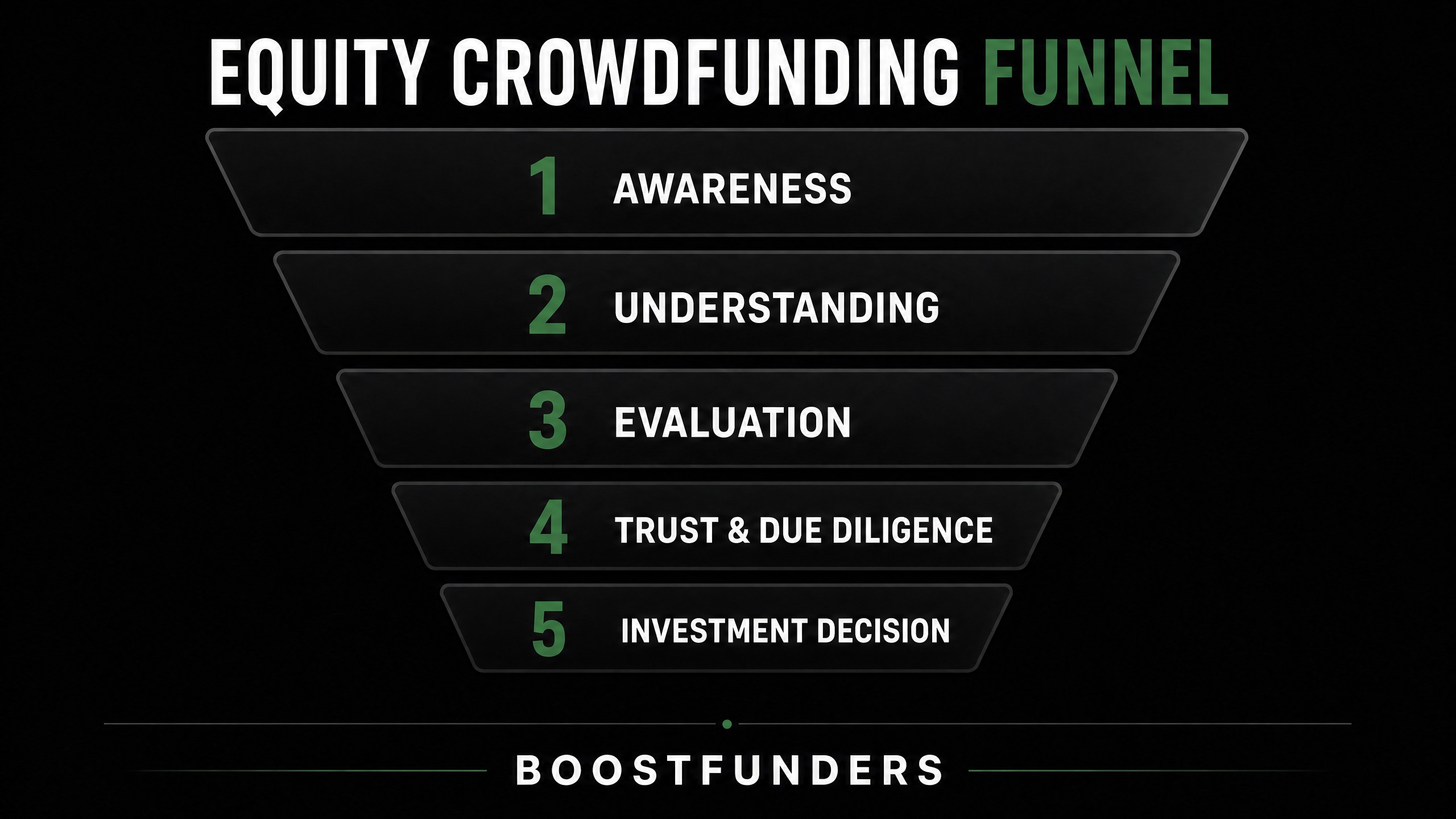
The Eight Stages of a Complete Investor Funnel
| Stage | Prospect State | Primary Objective |
|---|---|---|
| 1. Awareness | Unfamiliar with company | Earn relevant attention |
| 2. Interest | Understands basic problem | Capture permission to follow up |
| 3. Qualification | Shows possible fit | Identify intent and segment |
| 4. Education | Needs context and proof | Build understanding and trust |
| 5. Evaluation | Reviews the opportunity | Support due diligence |
| 6. Commitment | Intends to invest | Create a clear path to action |
| 7. Completion | Starts platform process | Reduce avoidable friction |
| 8. Advocacy | Has invested or follows closely | Generate referrals and long-term community |
These stages connect. A founder who collects thousands of low-intent emails but doesn't educate them has an awareness database, not an investor funnel. A founder with excellent content but no lead capture has an audience, not a funnel. A campaign with strong traffic but weak completion has a conversion problem, not necessarily a traffic problem.
Step 1: Define the Raise Strategy and Investor Segments
The funnel begins with the raise itself. Marketing can't be designed in isolation from the target amount, minimum investment, instrument, valuation, timeline, business stage, and platform. Translate the fundraising goal into an investor model — a $250,000 raise could come from 2,500 investors averaging $100, 500 averaging $500, or 100 averaging $2,500, and each model requires a different audience size, trust level, and acquisition cost. Our companion guide on the best equity crowdfunding marketing strategies for startup founders covers the broader positioning and channel mix this funnel plugs into.
| Investor Segment | Why It May Matter | Most Persuasive Proof |
|---|---|---|
| Customers and users | Know the product or problem personally | Product value, loyalty, usage, roadmap |
| Founder network | Know the team or execution history | Founder credibility, progress, personal trust |
| Industry professionals | Understand the market mechanics | Market insight, differentiation, partnerships |
| Experienced startup investors Analytical | Evaluate risk and upside systematically | Traction, terms, team, defensibility |
| Fans and followers | Emotionally connected to the brand or founder | Vision, access, community ownership |
Step 2: Build the Investment Thesis and Message Architecture
The investment thesis is the compact logic of the opportunity. It shouldn't promise returns or hide risk — it should help a qualified reader understand why the company exists, why the opportunity may matter, what evidence supports the case, and what the current round is intended to accomplish.
[Company] helps [specific customer] solve [costly or urgent problem] through [differentiated solution]. The company has demonstrated [traction], operates in [market context], and is raising [capital purpose] to reach [specific next milestones].
Build the message in layers so every channel communicates the same story at the appropriate depth: headline, problem, solution, market, traction, business model, team, defensibility, raise, and offering. Every number, comparison, and forecast should be sourced and reviewed — if a non-specialist can't explain the company after the first screen, the funnel will lose people before they encounter the evidence.
Step 3: Create the Investor Lead-Capture System
The lead-capture system converts anonymous interest into permission to continue the conversation — a landing page, form, thank-you page, CRM, tracking, consent language, and an immediate follow-up email.
| Offer | Why It Works | Best Audience |
|---|---|---|
| Investor interest list | Simple path for updates and launch notification | Broad qualified audience |
| Founder briefing webinar | Allows education, questions, founder visibility | Warm leads and industry professionals |
| Company progress report | Packages traction and market context | Analytical or experienced investors |
| Product demonstration | Shows the solution operating in reality | Customers, users, technical audiences |
| Early-access community | Creates repeated interaction before launch | Fans, customers, affinity groups |
Avoid vague offers like "join our mailing list" — explain the value of subscribing. The thank-you page should confirm the subscription and offer one next step, since this is the first opportunity to distinguish casual leads from people willing to invest time in understanding the company.
Step 4: Qualify Leads and Build the Email Nurture Sequence
Qualification doesn't mean deciding who is legally permitted to invest — the platform and applicable rules govern that. Marketing qualification means identifying which leads are more likely to engage seriously, using lead source, relationship to the company, content consumed, and engagement — never wealth assumptions from a job title or neighborhood.
Email is the connective tissue of the funnel because it lets the company continue a structured conversation outside algorithmic feeds. Each message should answer one major question and move the reader to one next action.
| Purpose | Primary CTA | |
|---|---|---|
| 1. Welcome | Set expectations | Read the company overview |
| 2. The problem | Create relevance | See the problem evidence |
| 4. Traction | Build credibility | Review traction highlights |
| 5. Founder and team | Build trust | Meet the team / submit a question |
| 8. Raise and use of funds | Connect capital to milestones | View the official campaign |
| 9. Questions and risks | Support diligence | Review offering details and Q&A |
| 10. Momentum or deadline | Provide factual timing | Visit the campaign page |
Not every lead should receive the same sequence at the same pace — customers may need less product education and more company economics, while industry experts may need more differentiation and market proof. Use one primary call to action per email, link to the official campaign page for a live offering, and remove claims that can't be supported.
Step 5: Use Founder-Led Content to Create Trust
An equity campaign asks investors to trust future decisions, not just a present product. Founder-led content lets prospects evaluate how leadership thinks, communicates, and understands the market — one of the strongest ways to build confidence before a direct investment request.
- Problem expertise: industry breakdowns and customer pain that prove deep market understanding
- Building journey: product iterations, difficult decisions, and lessons that show execution rather than only pitching
- Traction and proof: customer stories, milestones, and data releases that go beyond vision
- Investor communication: FAQs, risks, and responses to questions that show transparency
Choose platforms based on the audience — LinkedIn for professional and founder-network reach, YouTube and podcasts for complex companies, and don't turn every post into a campaign advertisement. Publish several pieces of education and evidence for every direct promotional post.
Step 6: Activate the Warm Network and Anchor Investors
Warm-network activation isn't a mass message to every contact. It's a structured process for identifying people who already have a reason to listen — founders, employees, advisors, customers, previous investors, suppliers, and affinity communities — giving them context and inviting questions before directing them to the official offering.
A credible lead or anchor investor can improve early momentum and the quality of investor questions. Wefunder publishes guidance on onboarding a lead investor, and its expectations can involve a meaningful commitment relative to the funding goal — confirm current criteria directly with the platform, since requirements can change.
Agencies can build systems, content, ads, email, PR, and reporting. They cannot replace the founder's relationships or manufacture authentic early conviction.
Step 7: Webinars, Events, PR, Partners, and Aligned Communities
Some prospects won't invest after reading emails and a campaign page — they need to hear the founder explain the company and ask questions directly. A founder briefing typically runs through the opening, company story, product and customer, market and model, traction, the raise, and 15–25 minutes of open Q&A.
External validation can expand the funnel, but only when the channel and story are genuinely relevant — a real news, product, or market milestone for PR; genuine strategic fit for partners; answering real questions rather than dropping links in industry communities.
Step 8: Use Paid Advertising and Retargeting Responsibly
Paid media can scale awareness and lead capture, but it should enter after the landing page, tracking, message, and nurture sequence are ready. Sending cold traffic directly to a complex investment page often produces expensive clicks and weak conversion, because the visitor hasn't received enough education.
| Campaign Layer | Objective | Primary KPI |
|---|---|---|
| Awareness | Video views, founder story, market education | Cost per engaged visitor |
| Lead generation | Investor waitlist, webinar, briefing, report | Cost per qualified lead |
| Nurture retargeting | Traction, FAQ, founder proof | Return visits, campaign visits |
| Campaign conversion Warm only | Official campaign review | Investment start, completed investor |
Do not treat a low cost per click as success — review the entire path from click to landing page, lead, campaign visit, investment start, and completed investment. Cheap clicks may come from curious but unqualified users who enjoy startup content but never invest.
Step 9: Convert Traffic on the Campaign Page
The campaign page is the central diligence and conversion asset. It shouldn't repeat the landing page word for word — the top of the funnel earns attention, but the campaign page must organize the evidence required for an investment decision.
- The first screen explains the company, customer, and value without jargon
- The pitch video is concise, founder-led, and consistent with written disclosures
- Traction uses dates, denominators, and definitions so the numbers aren't misleading
- Use of funds is tied to specific milestones rather than broad categories alone
- Risks and uncertainties are treated honestly, with official documents easy to find
Every unsupported claim, vague number, missing answer, or outdated update creates friction that paid traffic can't solve.
Step 10: Reduce Friction and Turn Investors into Advocates
A prospect may click the invest button and still fail to complete the process — the platform may require account creation, identity verification, or payment steps. The issuer shouldn't interfere with regulated checks, but can reduce avoidable confusion: link directly to the correct campaign page, keep deadlines and terms consistent across every channel, and direct technical questions to platform support.
The funnel doesn't end at investment. Community investors can become customers, referrers, and long-term advocates — send a prompt welcome, publish regular progress updates, and ask for introductions based on genuine fit.
📘 Read This FirstHow Wefunder Works: A Founder's Complete Guide
For the full mechanics of Wefunder listings, fees, and the raise process itself, this companion guide on the Boostfunders blog network pairs directly with the funnel strategy above.
Read the complete founder's guide on boostfunders.com →Investor Funnel Metrics and a Worked Model
A funnel becomes manageable when every stage has a measurable count, conversion rate, cost, and owner.
| Metric | Formula | What It Reveals |
|---|---|---|
| Landing-page conversion rate | Leads / unique landing visitors | Message, offer, and audience fit |
| Investment-start rate | Investment starts / campaign visitors | Campaign-page persuasion and intent |
| Completion rate | Completed investors / investment starts | Process, terms, and final confidence |
| Cost per investor | Attributable spend / attributed investors | Acquisition economics |
A worked, illustrative model for a $500,000 raise at a $1,000 average investment and a 4% campaign-visitor-to-investor conversion rate requires roughly 12,500 qualified campaign visitors — which, at a 45% lead-to-visit rate and 20% landing-page-to-lead rate, works backward to roughly 139,000 relevant landing visitors. This immediately shows why relying only on cold lead generation may be unrealistic — the founder can improve the economics by increasing average investment, improving lead quality, or activating a larger warm audience instead.
Equity investments may occur after multiple touches and on another device or browser. Use source tags, platform data, and timing analysis, but distinguish direct attribution from assisted influence — don't claim every investment after a campaign exposure was caused by that channel.
A 90-Day Investor Funnel Launch Plan
| Period | Primary Objective |
|---|---|
| Days 90–76 | Strategy and compliance foundation — platform, counsel, target model, segments |
| Days 75–61 | Message and assets — thesis, landing page, founder video, CRM and tracking |
| Days 60–46 | Audience building begins — warm-network mapping, organic content, paid tests |
| Days 45–31 | Nurture and qualification — email sequence, lead scoring, founder briefing |
| Days 30–16 | Soft-launch preparation — lead/anchor support, PR outreach, link testing |
| Days 15–8 | Launch mobilization — segmented emails, retargeting audiences, dashboard |
| Launch days 1–3 Critical | Activate prepared demand — warm outreach, email, founder content, rapid Q&A |
| Days 4–21 live | Educate and optimize — traction updates, FAQs, retargeting, investor conversations |
| Final phase | Factual urgency and completion — deadline communication, reactivation, welcome |
The timeline should expand when the company lacks traction materials or an existing audience. It may compress for a company with a large customer base and established communications — but legal, platform, and quality review should never be rushed merely to meet a marketing date.
Compliance-Sensitive Promotion Under Regulation Crowdfunding
This section is general educational information, not legal advice. Founders should work with the intermediary and qualified securities counsel before publishing campaign communications, ads, influencer content, or projections.
The SEC's Regulation Crowdfunding Guidance for Issuers states that an eligible issuer may raise up to $5 million in a 12-month period, and each offering must be conducted exclusively through one SEC-registered broker-dealer or funding portal that's also registered with FINRA. The regulated platform is the official center of the offering, not the company's marketing funnel.
The SEC's Rule 204 interpretations explain that an issuer may advertise offering terms outside the intermediary's channels, but such a notice is limited to specified information — amount offered, security type and price, closing date, planned use of proceeds, and progress toward the funding target.
Route the actual investment transaction through the official intermediary. Have counsel and the platform review any communication that discusses offering terms, projections, or valuation. Never guarantee returns, liquidity, or funding success, and disclose promoter or compensation relationships as required — the FINRA-registered funding portal list is the place to verify an intermediary's registration.
Common Investor Funnel Mistakes
- Launching with no prepared audience — start list building and education 60–120 days earlier
- Targeting "startup investors" broadly instead of segmenting by relationship and evidence needs
- Sending ads directly to the campaign — use education and lead capture unless the audience is already warm
- Collecting emails with no nurture — the database never develops understanding or intent
- Overstating market size or projections — creates distrust and legal risk
- Optimizing for clicks — track qualified leads, campaign visits, and completed investors instead
- Disappearing after investment — maintain disciplined post-investment communication
Scale when lead quality is stable and conversion is healthy. Pause a channel when clicks rise but qualified leads don't, or when investor questions reveal a material trust problem. Rebuild when the target audience doesn't understand the problem, or the offering economics repeatedly create the same objection. A pause is not failure — it's a decision to stop purchasing more evidence of a known problem.
Conclusion
An equity crowdfunding investor funnel is not a collection of marketing channels — it's a decision system. It finds people with a credible reason to care, gives them a useful path into the company story, measures their interest, educates them with evidence, supports due diligence, and directs them to the official regulated offering when they're ready to evaluate it.
The strongest funnels are built before launch: raise strategy and investor segments, a clear investment thesis, lead capture, email nurture, founder content, warm-network activation, events, PR, and measured paid acquisition — ending with a campaign page and investment process that are understandable, consistent, and supported by timely communication.
The funnel must also stay grounded in reality. It can't replace traction, repair unsuitable terms through persuasion, or guarantee funding. If you'd like help building the funnel end-to-end, submit your project here — we review every submission within 2 hours.
Frequently Asked Questions