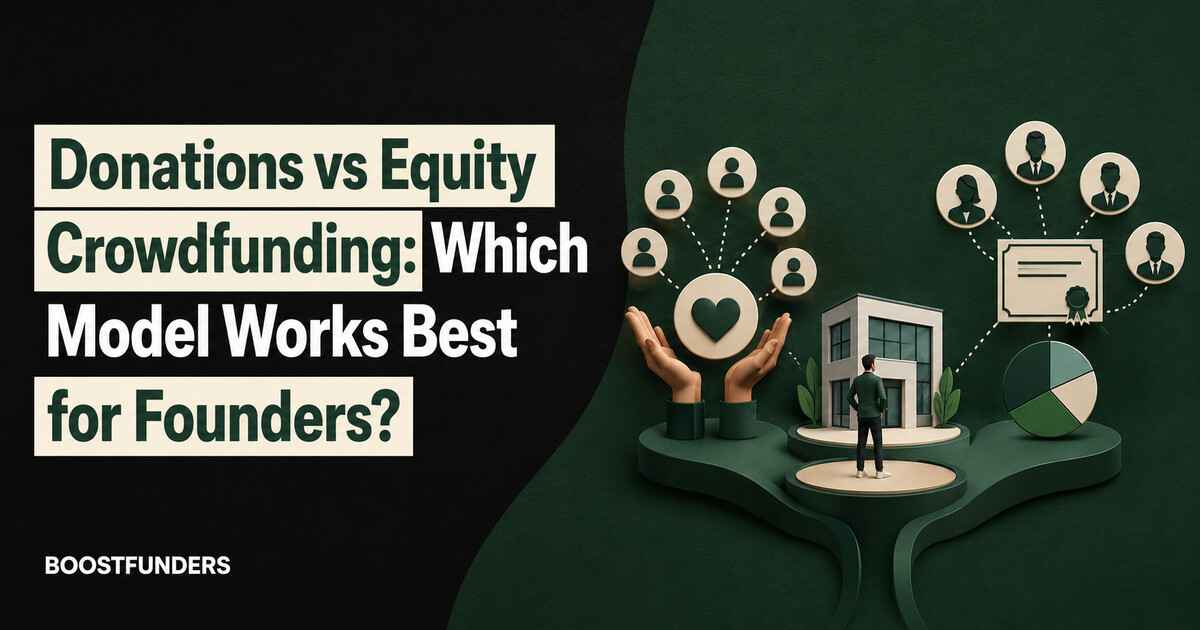
Crowdfunding looks simple from a distance: put a story online, set a target, share the link, and let the crowd fund the next step. But founders who get serious about fundraising quickly discover that the word "crowdfunding" hides very different financial relationships. A person who donates $100 to a community project is not doing the same thing as a person who invests $100 in a startup through a regulated equity offering.
That difference changes almost everything — what the contributor expects, what the founder owes in return, how the campaign can be marketed, how much disclosure is required, what happens to ownership, how taxes may be treated, and what responsibilities remain after the money arrives. A donation campaign can be lighter and faster, but it can be a poor fit for a commercial startup asking strangers to finance private upside without sharing any of it. Equity crowdfunding can unlock larger growth capital and turn customers into owners, but it brings securities-law compliance, reporting, investor relations, and dilution.
The right question is not "Which model raises money more easily?" It is "Which model matches what we are building, why people would fund it, and what we are prepared to give or owe in return?"
This article is educational and U.S.-focused. Donation, tax, securities, charitable-solicitation, accounting, and corporate-law consequences depend on the facts, entity, jurisdiction, campaign structure, and what contributors receive. Founders should confirm their specific structure with qualified legal and tax advisers before launching.
Key Takeaways
- Pure donation crowdfunding gives contributors no ownership, financial return, or product entitlement — promising a product moves you toward rewards/preorder crowdfunding instead
- Equity crowdfunding is a securities offering. Under U.S. Reg CF, eligible companies can raise up to $5 million in a 12-month period through a registered intermediary
- Donation crowdfunding is usually strongest for causes, community projects, nonprofits, and mission-led projects where supporters expect no financial upside
- Equity crowdfunding is usually stronger for a scalable for-profit startup that needs growth capital and is willing to share future upside
- Donation money is not automatically tax-free, and a donor's payment is not automatically tax-deductible — the facts and recipient status matter
- For many product startups, rewards/preorder crowdfunding may be a better third option than either donations or equity
The Short Answer: Which Model Works Best?
For most founders, the answer depends on the nature of the venture rather than personal preference. If you are funding a cause, public-benefit project, nonprofit program, personal emergency, community initiative, or mission where supporters genuinely expect nothing financial in return, donation crowdfunding is often the cleaner fit. If you are funding a for-profit startup that intends to grow enterprise value and eventually reward owners, equity crowdfunding is usually the more coherent relationship with outside funders.
That does not mean every commercial startup should sell equity. Early founders may be better served by bootstrapping, customer revenue, grants, rewards crowdfunding, angel capital, venture funding, or debt. Equity crowdfunding makes the most sense when the company is ready to communicate publicly, handle a regulated offering, support investor diligence, and maintain a broader investor community after the raise.
Ask what the contributor is really funding. If they are funding an outcome they care about and expect no economic claim, think donation. If they are funding a company because they want a financial interest in its future, think equity. If they are paying to receive a product, think rewards/preorder crowdfunding.
What Donation Crowdfunding Actually Means
Donation crowdfunding is the simplest relationship on paper: supporters contribute money without receiving a security or financial return. In a pure donation campaign, the contributor is not buying shares, earning interest, receiving a SAFE, or obtaining a legal claim on the company's future value. The motivation is typically generosity, empathy, community identity, mission alignment, urgency, or a desire to help make something happen.
This model is common on platforms such as GoFundMe for personal causes, medical needs, memorial funds, emergency relief, community initiatives, education expenses, and nonprofit fundraising. It can also appear around social-impact ventures or founder-led community projects, but founders need to be precise about what is being offered. GoFundMe's organizer guidance distinguishes personal donations from transactions where goods or services are provided in exchange.
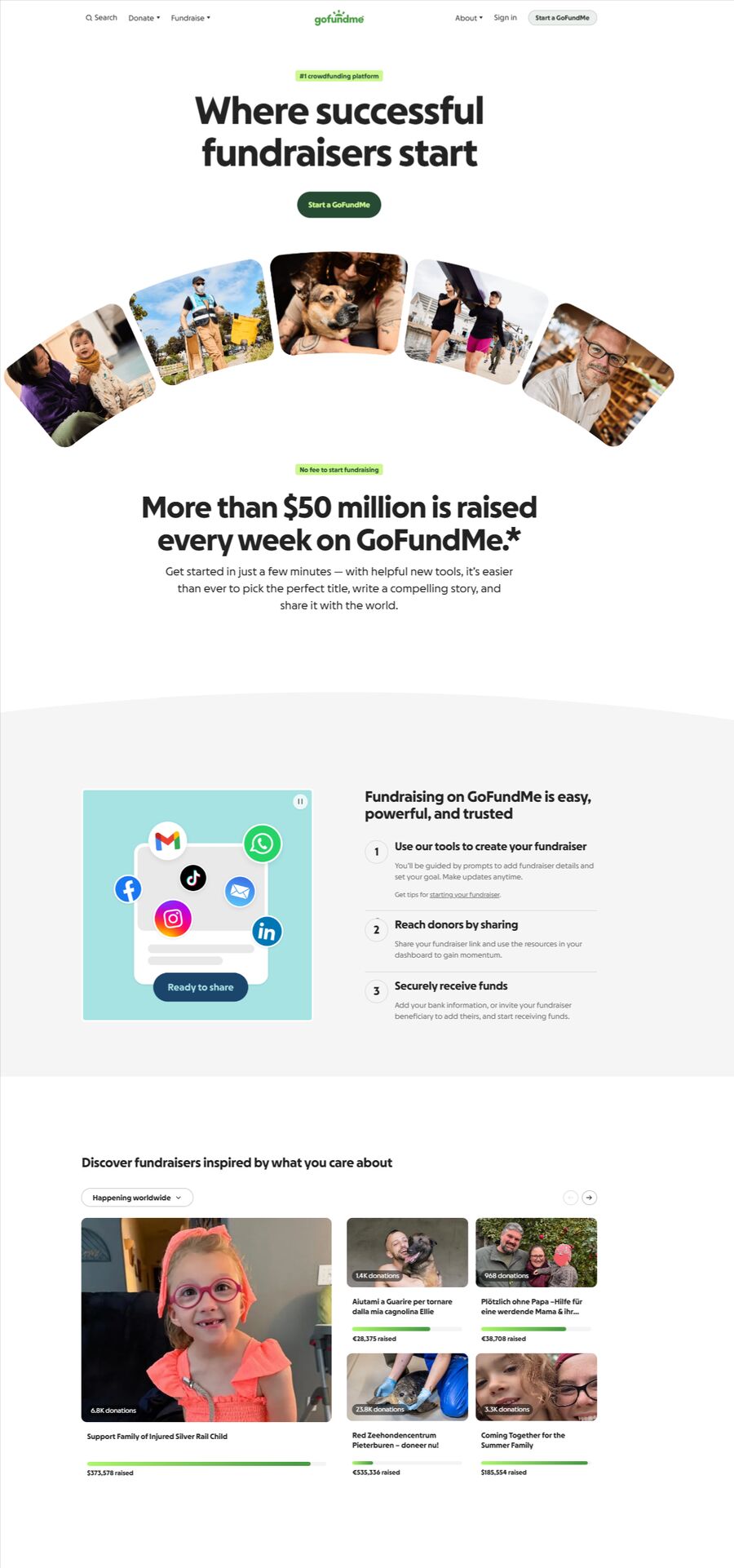
For practical promotion tactics, PledgeWire's GoFundMe Marketing Tips for Charity and Donation Campaigns explains how trust, personal outreach, updates, community distribution, and donor stewardship work in donation campaigns.
Donation Crowdfunding Is Not the Same as Rewards Crowdfunding
This distinction matters for startup founders. If a supporter gives $75 and receives nothing except a thank-you, that looks like a donation. If the supporter gives $75 because you promised to ship a product, give early access, or provide a perk, the relationship looks much more like rewards or preorder crowdfunding. That may still be a perfectly good funding model — it is simply not a pure donation.
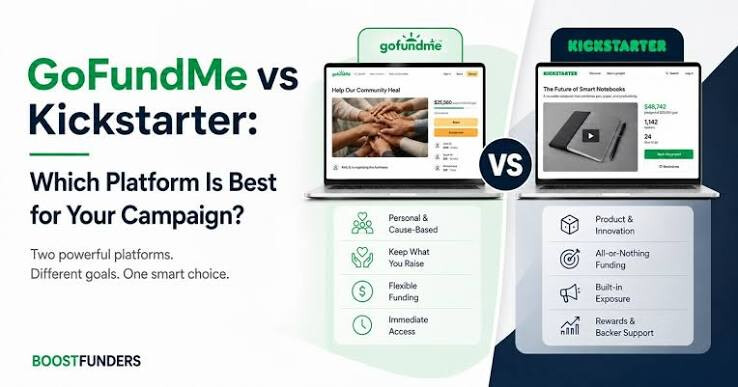
PledgeWire's GoFundMe vs Kickstarter: Which Platform Is Best for Your Campaign? and Boostfunders' comparison of equity versus rewards crowdfunding are useful companion reads when a founder is deciding whether the crowd should donate, preorder, or invest.
What Equity Crowdfunding Actually Means
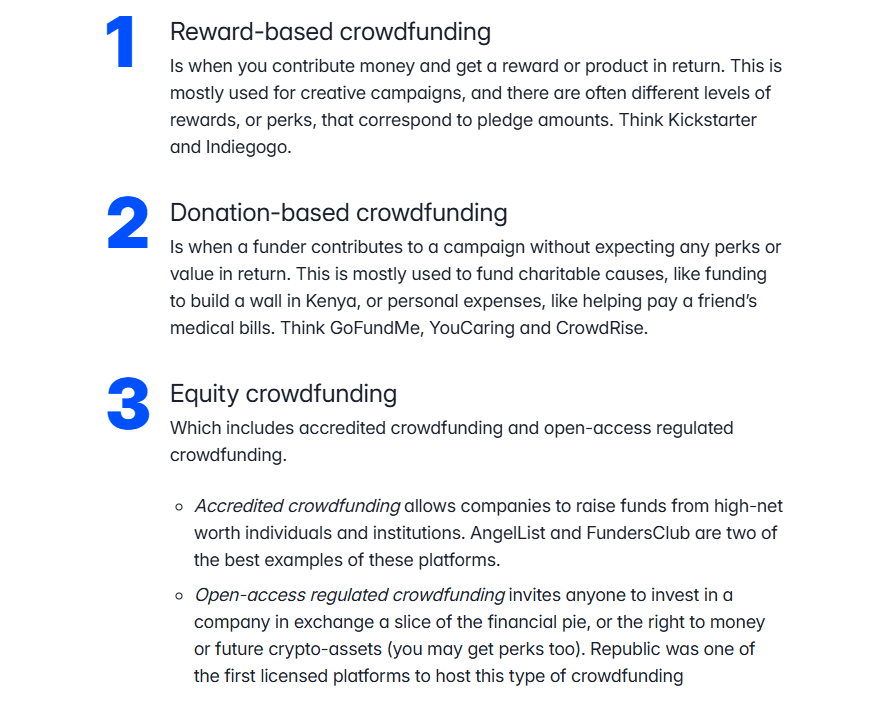
Equity crowdfunding is fundamentally different because contributors are investors. They are not simply supporting a mission; they are purchasing a security. Depending on the offering, that security may be common or preferred equity, a SAFE, a convertible note, debt, a revenue-linked security, or another instrument permitted by the offering structure.
In the United States, Regulation Crowdfunding — usually shortened to Reg CF — is one of the best-known pathways for online community raises. The SEC's current issuer guidance says an eligible company may raise up to $5 million in Reg CF offerings during a 12-month period. The offering must be conducted through a single SEC-registered broker-dealer or funding portal that is also a FINRA member, and issuers have disclosure, advertising, filing, and ongoing-reporting obligations.
The defining feature is not the website. It is the security. Wefunder's own explanation makes the same point: equity crowdfunding is fundraising in which investors receive a security with the expectation of possible financial upside, subject to the rules of the legal pathway being used.
For the mechanics, disclosures, financial-statement thresholds, advertising limits, and ongoing reporting, read PledgeWire's Reg CF Explained: What Founders Must Know Before Raising Equity.
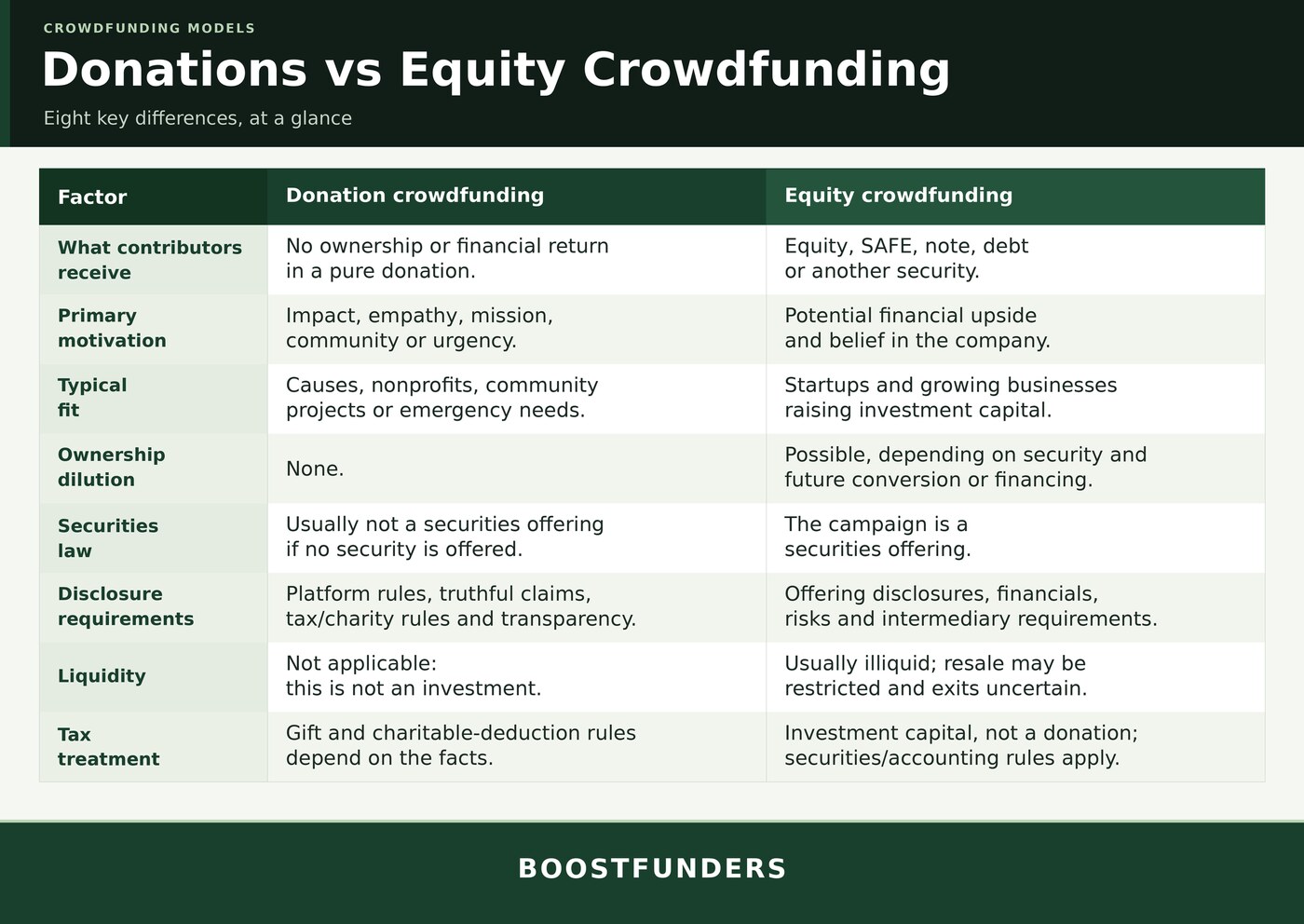
Donations vs Equity Crowdfunding: Side-by-Side
| Factor | Donation Crowdfunding | Equity Crowdfunding |
|---|---|---|
| What contributor receives | No ownership or financial return in a pure donation | A security: equity, SAFE, note, debt, or another offered instrument |
| Primary motivation | Impact, empathy, mission, community, urgency | Potential financial upside plus belief in the company |
| Typical founder fit | Cause, nonprofit, community/public-interest initiative, emergency need | For-profit startup or growth company raising investment capital |
| Ownership dilution | None | Possible, depending on security and future conversion/financing |
| Securities law | Usually not a securities offering if no security is offered | Core issue: the campaign is a securities offering |
| Disclosure burden | Platform rules, truthfulness, tax/charity rules, campaign transparency | Form C or other offering disclosures, financial information, risk factors, intermediary process |
| Liquidity expectation | Not applicable — it is not an investment | Usually illiquid; resale may be restricted and exits uncertain |
| Tax treatment | Facts matter; gifts and charitable deductions have specific rules | Investment capital is not a donation; securities/accounting treatment applies |
Ownership, Dilution, and Control
Ownership is the clearest structural difference. Donation crowdfunding does not require the founder to issue equity simply because people contributed money. If the campaign is genuinely donation-based, the supporter's contribution does not turn into shares later unless a separate legal agreement says otherwise.
Equity crowdfunding, by contrast, exists precisely because the founder is raising investment capital. If the security is stock, investors become owners immediately. If the security is a SAFE or convertible instrument, the investor may receive future equity when specified events occur. The exact economic and governance effect depends on the instrument, cap table, valuation or valuation cap, discount, voting structure, SPV arrangement, and future rounds.
Founders sometimes frame dilution as if it were automatically bad. That is too simplistic. Owning a smaller percentage of a much more valuable company can be a rational trade if new capital helps the business reach milestones it could not otherwise reach. The real question is whether the capital raised creates enough enterprise value to justify the ownership issued or promised.
If preserving 100% ownership is a hard requirement, equity crowdfunding is not the natural fit. If the company needs growth capital that cannot realistically be funded by donations or customer preorders, some dilution may be a reasonable price for acceleration. Before launching, model the cap table after the round and after a plausible future financing — not only on day one.
Why People Contribute: Donor Psychology vs Investor Psychology
Donation campaigns win when people believe the need is real, the organizer is credible, the money will be used responsibly, and their contribution will make a visible difference. The emotional engine is often empathy, identity, social responsibility, urgency, faith, local connection, or community belonging.
Equity crowdfunding asks for a more complex decision. An investor can love the mission and still decline the investment if the valuation looks aggressive, the market is unclear, the cap table is messy, the team lacks execution evidence, or the security is hard to understand. The investor is asking two questions at once: "Do I want this company to exist?" and "Am I comfortable risking capital on the terms being offered?"
| Donation Supporter Asks | Equity Investor Asks |
|---|---|
| Who or what does my money help? | What exactly am I buying? |
| Is this need authentic? | What problem does the company solve and how large is the market? |
| Can I trust the organizer? | Can I trust the team and the disclosures? |
| How will the money be used? | How will the capital create enterprise value? |
| What impact could my gift have? | What are the risks, dilution, and plausible paths to liquidity? |
| Can I share this with people who care? | Is this opportunity appropriate for my risk tolerance and portfolio? |
How Much Capital Is Each Model Built to Raise?
Donation crowdfunding can raise very large sums in exceptional cases, but its economics depend on generosity rather than ownership or product value. That makes it powerful for emotionally resonant causes and public-benefit campaigns, but much harder to scale for an ordinary commercial startup asking strangers to finance salaries, customer acquisition, manufacturing, or expansion while keeping all of the upside private.
Equity crowdfunding is designed for investment capital. Under Reg CF, the current federal maximum is $5 million in a 12-month period for eligible issuers. That does not mean every company should target the maximum; the appropriate raise size should be tied to a credible operating plan, milestones, runway, valuation, and the cost of running the round.
Ask: "How much capital can we responsibly deploy before the next value-creating milestone?" A smaller, well-structured raise can be more credible than a large target that does not connect clearly to hiring, product, revenue, or market-expansion milestones.
Legal and Compliance Burden
Pure donation crowdfunding is generally lighter than a securities offering, but "lighter" does not mean law-free. Organizers still need accurate claims, lawful fundraising activity, privacy protections, platform compliance, proper handling of funds, and — where relevant — compliance with charitable-solicitation, nonprofit, consumer-protection, sanctions, and tax rules. A founder also should not label something a donation while quietly promising investors a return later.
Equity crowdfunding has a much more formal regulatory architecture. Under Reg CF, the issuer uses a registered intermediary, files offering disclosures, provides financial information at the required level, follows advertising rules, addresses material changes, and generally has continuing annual-reporting obligations unless an exception permits termination. FINRA oversees registered funding portals and emphasizes that Reg CF offerings must be conducted through a registered broker-dealer or funding portal.
That compliance burden is not a reason to avoid equity crowdfunding if the model fits. It is a reason to budget for it and prepare before the marketing push begins. The founders who struggle are often not the ones with a bad company; they are the ones who treat a regulated capital raise like an ordinary social-media campaign.
Taxes and Accounting Are Not the Same Thing as Fundraising
One of the most dangerous crowdfunding myths is that money called a "donation" is automatically tax-free. The IRS says the tax treatment of crowdfunding distributions depends on the facts and circumstances. Money given out of detached and disinterested generosity, with nothing expected in return, may be treated as a gift; other crowdfunding receipts may be includible in gross income. A business campaign should not assume that every contribution is a nontaxable gift.
The donor side is equally important. GoFundMe states that donations to personal fundraisers are generally treated as personal gifts and are not generally tax-deductible to donors. Donations to eligible nonprofit fundraisers can have different treatment. The IRS likewise notes that gifts to individuals are not deductible and that deductible charitable contributions generally must be made to qualified organizations.
Equity crowdfunding is different again. The money is raised in exchange for a security, so founders should work with their accountant and counsel on how the issuance is recorded, how offering costs are treated, how SAFEs or debt instruments are accounted for, and what cap-table or tax reporting follows. This is one area where copying another campaign's setup can become expensive later.
Campaign Speed, Setup Cost, and Operational Friction
Donation campaigns can often be launched quickly because the organizer is not preparing a securities offering. A clear story, verification, payment setup, beneficiary details, campaign visuals, budget explanation, and distribution plan may be enough to get started. That speed is valuable in emergencies and time-sensitive community needs.
Equity crowdfunding usually takes longer. Founders may need entity cleanup, cap-table review, financial statements, offering terms, Form C preparation, campaign content, legal review, portal onboarding, banking/payment setup, investor communications, and a prelaunch marketing system. The raise can stay open longer than many rewards campaigns, but the preparation burden is higher.
| Operational Factor | Donation | Equity |
|---|---|---|
| Typical setup complexity | Low to moderate | Moderate to high |
| Legal/document preparation | Usually lighter | Meaningful securities and corporate work |
| Financial disclosure | Campaign budget and trust information | Formal offering and financial disclosures |
| Time to launch | Can be relatively fast | Usually requires substantial preparation |
| Post-close administration | Stewardship and impact updates | Investor relations, reporting, securities administration |
| Professional support | May need tax/nonprofit advice | Often legal, accounting, portal, marketing, cap-table support |
Marketing a Cause vs Marketing an Investment Opportunity
The same ad creative should not be used for both models because the audience is making a different decision. Donation marketing works best when the need is human, specific, verifiable, and easy to act on. Equity marketing works best when the company is understandable, the opportunity is credible, the founder communicates like a real operator, and the campaign gives investors enough evidence to evaluate the risk.
What Donation Marketing Needs to Communicate
- The need — What happened, what needs to be funded, and why now
- The beneficiary — Who benefits and how the organizer is connected to them
- The use of funds — A simple budget that makes the ask tangible
- The proof — Authentic images, documentation where appropriate, updates, community validation
- The action — Donate, share, introduce, volunteer, or match
What Equity Crowdfunding Marketing Needs to Communicate
- The problem and market — Why a meaningful customer problem exists and why the market matters
- The solution — What the company does and why it can win
- The traction — Revenue, users, pilots, retention, partnerships, product progress, or other credible evidence
- The team — Why these founders can execute
- The raise — What the capital is intended to accomplish
- The risks and terms — Investors need access to the formal offering information, not only promotional content
For a deeper breakdown of investor acquisition, see PledgeWire's Best Equity Crowdfunding Marketing Strategies for Startup Founders. The companion How to Build an Investor Funnel for an Equity Crowdfunding Campaign explains how to move prospects from awareness to education, diligence, and completed investment.
Transparency, Proof, and Trust Requirements
Donation campaigns and equity campaigns both depend on trust, but they prove trust differently. Donation organizers need to prove the need, identity, connection to the beneficiary, responsible use of funds, and continuing impact. Equity issuers need to prove those softer elements plus business facts: traction, customer evidence, financial condition, market assumptions, capitalization, risk factors, material relationships, and the economic terms of the security.
A polished page cannot substitute for credible evidence in either model. In donation campaigns, vague beneficiaries and unclear fund use trigger skepticism. In equity campaigns, a cinematic founder video cannot compensate for unsupported market claims, missing financial context, or a valuation no one can defend.
Can a stranger understand where the money goes in under 60 seconds? Can the organizer or company prove the claims that matter most? Would the campaign still sound credible if every superlative were removed? Does the page answer the uncomfortable questions, not only the exciting ones?
What Happens After the Campaign Closes?
A donation campaign may end when the financial need is met, but the relationship should not disappear. Supporters expect acknowledgment, progress updates, evidence of impact, and an explanation of what happens if the campaign raises less or more than planned. Good stewardship can turn one-time donors into long-term advocates.
Equity crowdfunding creates a longer relationship by design. Investors may need annual reports, material updates, tax documents or platform communications depending on the structure, and continued visibility into the company's progress. Founders also have to manage expectations: startup investing is illiquid, exits are uncertain, and communication should not turn into a stream of promises about returns.
When Donation Crowdfunding Is the Better Model
Donation crowdfunding tends to work best when the campaign can make a morally or socially coherent ask without offering economic ownership. That usually means the contributor is helping an outcome rather than financing a private asset they expect to appreciate.
- Personal and emergency needs — Medical bills, recovery costs, memorial funds, disaster response, relocation, or hardship support
- Registered nonprofit campaigns — Programs, capital projects, relief work, scholarships, community services, and mission fundraising
- Community or public-benefit projects — Local facilities, mutual-aid initiatives, cultural projects, neighborhood restoration, or civic needs
- Mission-led projects with no investor-return logic — Open-source, educational, social, or advocacy initiatives where supporters want the work to exist rather than own it
- Very early validation of community willingness to support a cause — Provided the ask is honest and does not imply future ownership or product entitlement
A for-profit founder can still receive gifts in some situations, but the fundraising story becomes harder as the venture becomes more commercial. If supporters are effectively financing a company that plans to build significant private value, many will reasonably ask why they are being asked to donate rather than buy the product, receive a perk, or participate in the upside.
When Equity Crowdfunding Is the Better Model
Equity crowdfunding becomes more compelling when the company has moved from "help us exist" to "help us grow." A commercial venture with an investable business model, credible traction, a defined use of funds, and a community that wants to participate in ownership can make a stronger case for equity than for donations.
- The company is for-profit and growth-oriented
- The capital need is material and tied to clear milestones
- There is enough traction to support public investor diligence
- The founders are willing to issue a security and accept dilution or conversion obligations
- The team can support legal, accounting, portal, investor-relations, and reporting work
- Customers or community members already identify strongly with the brand and may value becoming investors
- The company can explain risks without damaging the entire investment story
Boostfunders' What Is Equity Crowdfunding and How Does It Work in 2026? gives a broader overview of how the model works in 2026. For a platform-specific founder view, see Boostfunders' How Wefunder Works: A Founder's Complete Guide.
When Neither Model Is the Right Answer
Founders sometimes force themselves into a donation-versus-equity choice when the better answer is a third funding model. The most common example is a product startup. If customers are willing to pay for an early version of the product, rewards or preorder crowdfunding may validate demand without asking for donations and without issuing securities.
| Founder Situation | Often Worth Considering |
|---|---|
| Consumer product with prototype and strong preorder appeal | Rewards/preorder crowdfunding |
| Research or social innovation with grant eligibility | Grants / foundations / public funding |
| Business with predictable cash flow and ability to repay | Debt / revenue-based financing |
| High-growth startup with institutional network and large capital need | Angel / VC / private round |
| Founder can reach milestone from revenue | Bootstrapping / customer financing |
| Cause-led project with no economic return | Donation crowdfunding |
| Community-backed for-profit with investable traction | Equity crowdfunding |
If you are deciding between product rewards and startup investment, PledgeWire's Wefunder vs Kickstarter: Key Differences for Founders is a useful comparison.
Can Founders Combine or Sequence the Two Models?
Sometimes, but founders need to be careful. A social venture may have a nonprofit arm that accepts charitable donations and a separate for-profit company that raises investment capital. A founder may also run a genuine community-support campaign at one stage and later launch a securities offering for a commercial company. What matters is that the legal entities, uses of funds, promises, and contributor expectations are not blurred.
Do not tell donors they are "basically early investors" if they are not receiving a security. Do not market a donation as a way to "get in early" on future financial upside. And do not assume that money raised for a charitable purpose can be freely moved into a founder-owned business. These are areas where legal and tax advice is worth the cost.
Each campaign should be able to stand on its own. A donor should understand exactly what they are giving to and receive no implied investment promise. An investor should receive the formal security and disclosures through the proper offering process. Clear separation protects trust as much as it protects compliance.
A Practical Founder Decision Framework
Use the questions below before choosing a platform or building campaign creative. If the answers point in different directions, that is a sign to revisit the business model and capital plan before launch.
| Decision Question | What the Answer Tells You |
|---|---|
| What exactly are people funding? | A cause or outcome points toward donations. A company's growth points toward investment. |
| What does the contributor receive? | Nothing economic suggests donation. A product suggests rewards. A security suggests equity. |
| Is the entity nonprofit, for-profit, or a combination? | Entity structure affects tax, solicitation, and securities considerations. |
| How much capital is actually needed? | A modest community need may suit donations; substantial growth capital may justify equity. |
| What evidence exists today? | Equity investors generally expect more diligence-ready proof than donors. |
| Can the team support compliance? | If not, equity crowdfunding may be premature. |
| Is the founder willing to share upside? | If the answer is absolutely no, do not choose equity simply because the platform has investors. |
| What relationship do you want after the raise? | Donor stewardship, customer fulfillment, and investor relations are three different operational commitments. |
Three Founder Scenarios
Scenario A — a neighborhood food-rescue initiative: A volunteer-led initiative needs $35,000 to purchase refrigerated storage and distribute surplus food. There is no business equity to offer and the project's success is measured in community impact rather than enterprise value. Donation crowdfunding, local sponsorships, grants, and nonprofit partnerships are more coherent than an equity raise.
Scenario B — a SaaS startup with recurring revenue: A software startup has paying customers, growing annual recurring revenue, a functioning product, and needs $750,000 to hire sales staff and expand into a second market. Equity crowdfunding may fit because the use of funds is commercial growth, the company can present measurable traction, and supporters can participate through a security rather than being asked to subsidize private upside with gifts.
Scenario C — a new hardware product with no traction yet: A founder has a working prototype and needs $120,000 for tooling and first production. The strongest question may not be donations or equity at all. If customers will preorder the product, rewards crowdfunding could validate demand and fund production without adding shareholders. Equity might become more attractive later, after the product proves demand and the company needs growth capital rather than launch capital.
Common Mistakes to Avoid
- Calling a product preorder a donation. If the supporter expects a product or service, describe the relationship accurately.
- Calling a donation an investment. Donors should not be led to believe they will receive equity, profit participation, or a guaranteed future benefit.
- Assuming donations are automatically tax-free or deductible. IRS and platform guidance make clear that facts and qualified-organization status matter.
- Choosing equity only because the target is larger. A bigger funding goal does not make a company investment-ready.
- Ignoring dilution until the campaign is live. Model ownership and future financing before setting terms.
- Launching equity crowdfunding without a warm investor funnel. A portal is infrastructure, not a substitute for investor demand.
- Using cause-style emotional marketing for a weak investment case. Mission can attract attention, but investors still need business evidence and risk disclosure.
- Going silent after funds arrive. Donors expect impact reporting; investors expect disciplined company communication.
- Mixing nonprofit and for-profit funds casually. Separate entities and restricted funds need proper legal and accounting treatment.
- Treating compliance review as a last-minute obstacle. Build legal and tax review into the campaign schedule, not after the creative is finished.
Reg CF Explained: What Founders Must Know Before Raising Equity
Understand the disclosure and compliance framework behind equity crowdfunding offerings before you decide between donation and investment models.
Read the full guide →Final Verdict: Choose the Relationship Before the Platform
Donation crowdfunding and equity crowdfunding can both mobilize a community, but they are built on different promises. Donation crowdfunding says: "Help us make this outcome possible." Equity crowdfunding says: "Take the risk of becoming an investor in this company under these terms." One is not a lighter version of the other.
For a cause, nonprofit, emergency, community project, or mission-led initiative where contributors genuinely expect no economic return, donations can be direct, human, and effective. For a scalable for-profit startup seeking meaningful growth capital, equity crowdfunding is usually the more honest model if the company is investment-ready and the founders are prepared for the legal, financial, and investor-relations responsibilities that come with it.
And for many founders, the smartest answer is neither. A product company may be better off validating demand with rewards crowdfunding. A research project may be grant-funded. A profitable company may use debt. The best funding model is the one that matches the company's stage, the audience's motivation, and the founder's willingness to deliver what the funding relationship actually requires.
Do not choose a crowdfunding model because the platform looks popular. Choose it because the economic relationship makes sense. When the relationship is clear, the campaign story, compliance plan, marketing funnel, and post-campaign obligations become much easier to design.
Frequently Asked Questions