Here is the truth most founders discover the hard way: launching a campaign on Wefunder does not automatically bring investors. Wefunder gives you one of the most powerful equity crowdfunding platforms in the United States, but the platform provides the infrastructure, not the momentum. The investors have to come from somewhere — and that somewhere is almost always your own marketing effort.
Campaigns that treat the raise like a targeted marketing sprint consistently outperform those that simply publish a page and hope. The most successful Wefunder campaigns routinely reach roughly a quarter of their funding goal within the first 72 hours — momentum that is nearly impossible without a warm audience waiting before launch day. Our own guide to building an investor funnel covers the underlying system; this guide walks through the specific tactics for Wefunder itself — audience definition, pre-launch building, storytelling, email, social, PR, paid ads, Wefunder's own platform tools, compliance, and budgeting.
A public launch with no soft-committed capital is a cold launch, and cold launches read as risky to skeptical investors. A campaign that visibly has 25% committed on day one reads as validated — and validation is what converts passive observers into investors.
Key Takeaways
- Wefunder gives your raise infrastructure, not momentum — momentum has to come from your own marketing
- Wefunder's four-phase structure sets clear targets: 25% soft-committed before public launch, 65% before closing, 100% at the finish
- A warm pre-launch audience (500+ email contacts, soft commitments) is what makes a public launch look validated instead of cold
- Email outperforms every other channel because it reaches people who already showed interest, not an algorithm's audience
- Paid ads should amplify an already-working organic engine — never rescue a campaign that has no story or social proof
- Reg CF marketing carries real compliance rules: no promised returns, no offering terms in ads, no individualized investment advice
Understanding Wefunder Marketing vs. Normal Marketing
Promoting an investment is fundamentally different from promoting a product. When you market a product, your customer asks, "Do I want this product?" When you market an equity raise, your potential investor asks, "Do I believe this company can grow — and am I willing to risk my money on it?" That is a completely different level of trust to earn.
On Kickstarter, you are asking people to buy a product that will be delivered. On Wefunder, you are asking people to believe in a company by purchasing securities — equity, SAFEs, or other instruments — that may not produce a return for years, if ever. Wefunder states this plainly on every campaign page: investing is risky, you could lose all your money, and there is no promise of a return. For a side-by-side on the two models, see our Wefunder vs. Kickstarter comparison.
Your marketing cannot erase that reality, and it should not try. What it can do is build confidence through proof, transparency, and consistency — and it works best when it starts weeks before your campaign goes live, not after.
The Wefunder Campaign Lifecycle and What Promotion Looks Like at Each Stage
Wefunder organizes every raise into four distinct phases, and your promotion strategy should be built around them. The tactics that work in phase one would be wasted in phase three.
| Phase | What Happens | Promotional Focus | Target |
|---|---|---|---|
| 1. Pre-Launch | Build your pitch, video, highlights, onboard a lead investor | Audience building, email capture, warmup content | 0% — ready to launch |
| 2. Soft Launch | 1:1 outreach to angels, friends, family, and customers via reservations | Personal emails, DMs, calls, private announcements | 25% of goal |
| 3. Public Launch Highest reach | Open the raise via social, ads, PR, and Wefunder marketing perks | Mass channels, media kit, weekly updates, paid media | 65% of goal |
| 4. Closing | Final two weeks — re-contact everyone, increase commitments | Reminder sequences, social proof, deadline messaging | 100% of goal |
Notice the targets embedded in that structure: 25% before public launch, 65% before closing, 100% at the finish line. These numbers are not decoration. A public launch with no soft-committed capital is a cold launch, and cold launches read as risky to skeptical investors.
Step 1: Define and Segment Your Target Investors
Many founders make the same mistake on day one: "Anyone can invest in Reg CF, so everyone is my audience." That logic sounds inclusive, but it's strategically lazy. The more specific your audience, the stronger your messaging becomes — and specific messaging is what gets people to open emails, click ads, and actually invest.
Build investor personas based on your business model, industry, and growth stage, then dig beyond demographics into psychographics — motivations, values, and risk tolerance.
- Existing customers and product users — they already understand the value you deliver
- Newsletter subscribers and community members — the audience you control, not rent
- Industry professionals and LinkedIn connections — they can evaluate the market claims
- Angel investors, friends, and family — the fastest path to the soft launch threshold
- Mission-driven supporters — investors who back the story as much as the spreadsheet
Geography deserves special attention. Local investors consistently show a stronger connection to businesses in their area and are easier to activate through regional media and hometown pride. Look at your own data before building personas from thin air — your customer base, website analytics, and email subscribers are ready-made segmentation sources.
Step 2: Build a Warm Pre-Launch Audience
The pre-launch phase is where most campaigns are won or lost, even though most founders skip it. Your investor list — email subscribers, product users, past customers, waitlist leads, warm investor contacts — is the most valuable asset you will own during the raise, because it's the only audience you control rather than rent from an algorithm.
The goal is not merely to collect emails. The goal is to build a warm audience that already understands your company before the raise goes live, so launch day feels like a continuation of a conversation rather than a cold ask.
| Stage | Goal | Example Call-to-Action |
|---|---|---|
| Awareness | Introduce the company | "See what we're building" |
| Interest | Capture emails | "Join the investor interest list" |
| Education | Build confidence | "Read our founder story" |
| Warmup | Prepare commitment | "Get notified when the raise opens" |
| Launch | Drive action | "View the Wefunder campaign" |
Aim for a minimum of 500 warm email contacts prepared before you go live, and work toward having a meaningful share of your goal soft-committed by launch day — people who tell you they will invest as soon as the campaign opens, whom you then convert through personal follow-up in the soft launch phase.
Step 3: Craft a Campaign Story That Converts Skeptics Into Investors
Investors do not invest in numbers alone; they invest in a story they believe can become valuable. Your Wefunder page should never feel like a pitch deck copy-pasted into a website. It should feel like a founder explaining a real opportunity clearly, honestly, and confidently.
Compare a weak story — "We are building an app and raising money to grow" — against a strong one: "We are solving a real problem in a growing market, we already have early traction, customers are responding, and this raise helps us move from proof of concept to scale." The second version answers what an investor actually needs answered: what you do, why the market matters, why now, what traction exists, who is behind the company, and how the funds will be used.
Equally important is the trust layer: a founder video, a working product demo, customer testimonials, revenue or user-growth traction, press mentions, team bios, a credible roadmap, a clear use-of-funds breakdown, and honest risk disclosures. Do not hide the hard parts — smart investors expect risk, and what they want is honesty.
Step 4: Activate Your Own Network (The Soft Launch)
Wefunder's official playbook designates the soft launch as phase two for a reason: your first investors should come from your own network, not paid traffic. This phase runs on 1:1 outreach — personal emails, direct messages, and phone calls to existing angels, friends and family, customers, and anyone who can help you cross the 25% threshold.
-
1.
Onboard a lead investor early.Wefunder recommends a lead investor who commits a minimum of $5,000 or roughly 5–15% of your funding goal, and who holds the voting right on behalf of investors in a Community Round SPV. A credible lead investor is the strongest social proof a new campaign can display.
-
2.
Offer early access as an incentive.Let your inner circle reserve before the public launch — it creates urgency and gives them ownership of your story, and early backers become your most vocal promoters.
-
3.
Follow up personally on every reservation.A reservation is an intention, not an investment. Founders who message each reserved investor directly convert at multiples of the rate of those who simply wait.
The soft launch also compounds into the public launch. When strangers visit your campaign page and see substantial capital already committed by dozens of investors, they conclude that other people have vetted this company. You are no longer asking them to be first — you're asking them to join something that is already moving.
Step 5: Email Marketing for Wefunder Campaigns
Email is the highest-converting channel in equity crowdfunding, full stop. Unlike social media, where reach depends on algorithms, email delivers your message directly to people who have already shown interest. A strong Wefunder email sequence should educate before it asks:
- The Founder Story — explain why the company exists
- The Problem — show the pain point and why it matters
- The Opportunity — explain the market and growth potential
- The Traction — show customers, revenue, partnerships, or validation
- The Raise Announcement — tell your list the campaign is live
- The Momentum Update — share early traction and investor progress
- The Reminder — encourage action before the deadline or milestone
Three rules consistently win: write from a person, not a brand; send with a clear purpose per email — one message, one call to action; and maintain consistency, since most investors do not convert on first contact and a planned weekly cadence outperforms sporadic bursts. Wefunder itself supplies ready-made email and SMS templates in its Help Center, including nine-email sequences, as a starting skeleton to personalize.
Wefunder Community Round Promotions
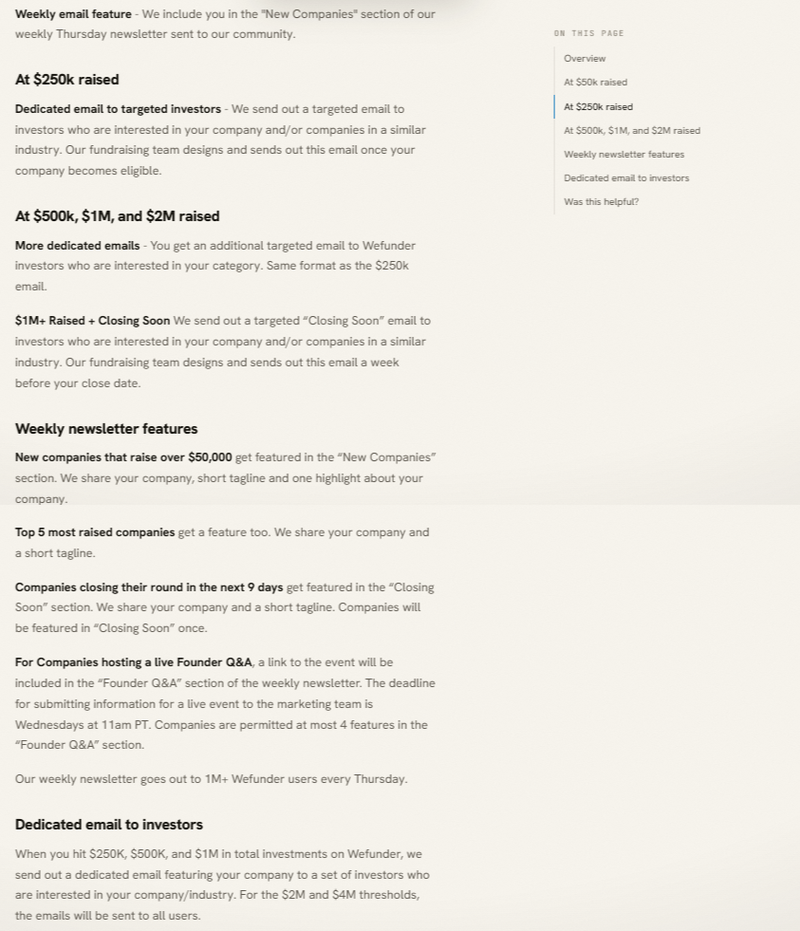
Beyond your own outreach, Wefunder runs its own email marketing on your behalf — but only once you hit certain funding thresholds. At $250K, $500K, $1M, and $2M raised, Wefunder's team sends a dedicated email featuring your company to investors interested in your category, and companies raising $1M+ that are closing soon get an additional "Closing Soon" email a week before their close date. Founders also get featured in Wefunder's weekly newsletter — sent to over 1M users every Thursday — once they cross $50,000 raised, and the top-5 most-raised companies get an ongoing feature slot.
| Milestone | What Wefunder Does |
|---|---|
| $50,000 raised | Eligible for a feature slot in Wefunder's weekly newsletter, sent to 1M+ users every Thursday |
| $250,000 raised | Dedicated email featuring your company sent to investors interested in your category |
| $500,000 raised | Another dedicated category-investor email at this threshold |
| $1,000,000 raised | Dedicated email, plus a "Closing Soon" email one week before your close date if applicable |
| $2,000,000 raised | Dedicated email at this threshold |
| Top 5 most-raised | Ongoing feature slot across Wefunder's own channels |
To be considered for a Community Round feature — where Wefunder promotes your raise directly to its platform and community investor base — reach out to their fundraising team at [email protected]. It's worth flagging this early in your raise planning, since the feature is tied to hitting specific raised-amount milestones rather than something you can request outright at will.
Step 6: Founder-Led Social Media Strategy
For a Wefunder campaign, the founder is the campaign. Investors are betting on you as much as on the business, which makes founder-led content the most trustworthy content you can publish. The best platforms are LinkedIn (professional audiences, accredited investors), X (real-time milestone updates), Instagram (behind-the-scenes Stories and Reels), Facebook (retail investors and community groups), and YouTube (long-form pitch videos).
The content strategy that converts follows a simple pattern: show, don't announce. Share your founder journey transparently, show your face regularly in video, and highlight others in your ecosystem by recognizing investors publicly. Post from your personal accounts rather than only the company page.
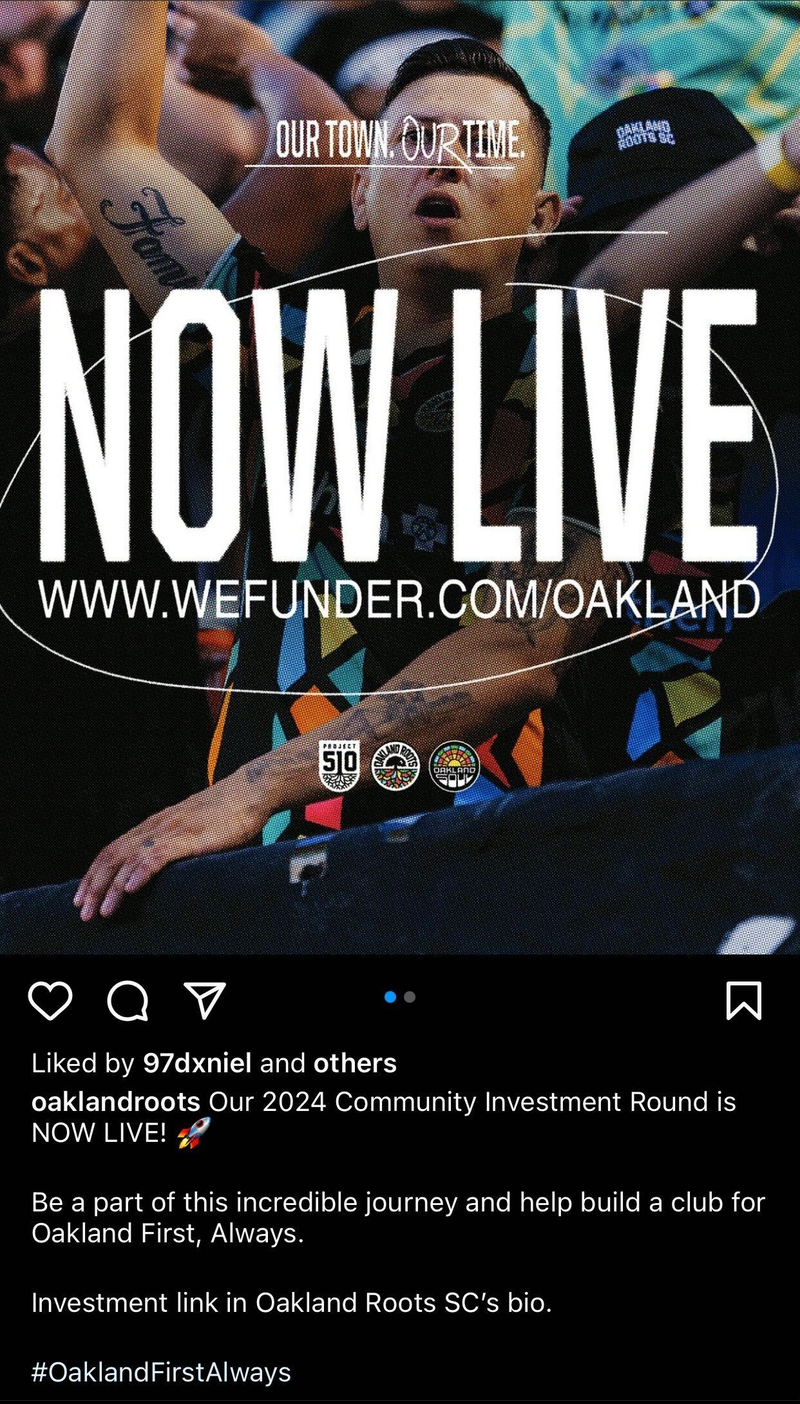
A feed full of "we're live!" posts with campaign links is promotional noise, and investors learn to scroll past it. Engagement beats broadcasting — reply to comments, ask questions, and tie the raise to the mission rather than the transaction.
Step 7: PR, Media, and Community Outreach
You do not need TechCrunch to move your campaign — you need the right story in the right publication. For most Wefunder founders, niche outlets deliver better results than chasing mainstream coverage: local news, industry publications, founder-focused podcasts, and YouTube channels in your vertical.
Create timely angles by connecting your raise to recent traction, market developments, or a product launch — journalists need a news hook, not a fundraising announcement. Then integrate every piece of coverage into the campaign itself: press logos, excerpts, and article links on your Wefunder page. Media coverage rarely delivers massive traffic volume, but it dramatically improves conversion by validating hesitant prospects.
Podcasts deserve particular attention because they put your founder story in front of a pre-warmed, trusting audience for 30–60 minutes. Micro-influencers in your niche frequently outperform larger personalities because their audiences are focused and trust is high. Finally, prepare a simple media kit — cover image, logo pack, founder photo, a short description, and key stats — so anyone who wants to share your raise can do it in minutes.
Step 8: Paid Ads and Retargeting (Done Right)
Paid advertising works for Wefunder campaigns — but only as an amplifier of what is already working, never as a rescue mechanism for an underperforming raise. Run cold acquisition ads into a page with no social proof, no warm audience, and a weak story, and you will burn capital on clicks that never convert.
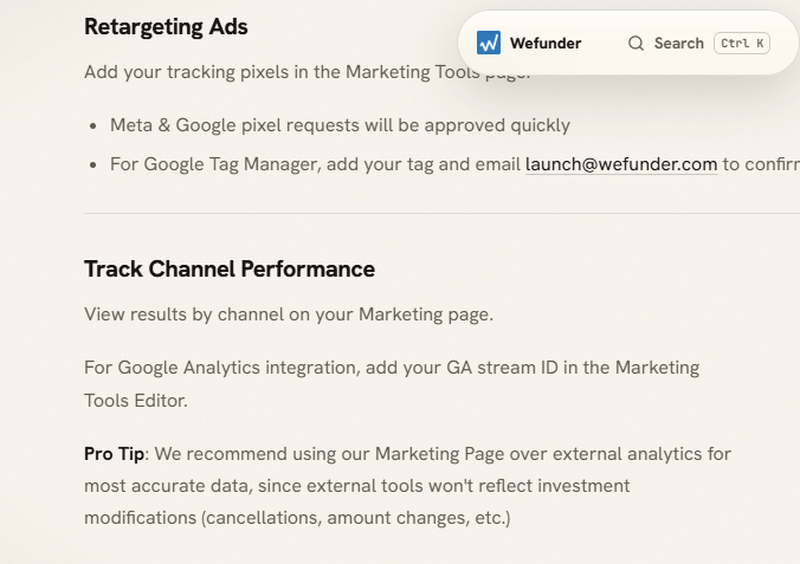
Install tracking pixels before you spend a dollar so you can build retargeting audiences from page visitors and video viewers. Retarget first, prospect second — the highest-ROI audience is people who already engaged with your campaign but haven't invested yet. Use proven messaging: traction metrics, founder story clips, and urgency indicators consistently outperform generic campaign branding.
Meta (Facebook/Instagram) ads offer detailed targeting for retail investors — job titles like "founder" or interests in startups and investing — while LinkedIn ads suit B2B companies courting professional investors, and Google Ads capture high-intent searchers looking for startup investment opportunities. Start small to test creative and audiences, then scale the winners and kill the losers. Prioritize mobile-optimized vertical video over text-heavy statics, since most potential investors will see your ads on a phone.
Wefunder does not sell paid promotion placements in the traditional ad sense, so your paid media budget must come from your own campaigns and channel choices — which makes pixel setup and retargeting discipline even more important. Ads involving securities and offering terms are compliance-sensitive; see the Regulatory Rules section below before you spend.
Step 9: Leverage Wefunder Updates and Platform Tools
Most campaigns treat Wefunder's built-in update system as an afterthought. That's a significant missed opportunity, because every update you publish triggers a notification to everyone following your campaign — a built-in re-engagement engine that costs nothing.
The updates that perform best share concrete traction (a milestone reached, a partnership signed), authentic behind-the-scenes content, and public recognition of new investors — who frequently share that recognition with their own networks. Wefunder's playbook recommends publishing updates on a weekly cadence with a full content calendar across the campaign. Every update should do at least one of three jobs: generate excitement, build credibility, or drive investment action.
Step 10: Close Strong in the Final Two Weeks
The closing phase is where disciplined campaigns pick up their biggest final surge. Wefunder's own playbook dedicates a full phase to it: in the last two weeks, re-contact everyone you have ever spoken to during the raise, ask existing investors whether they will increase their commitment, and drive deadline urgency to close at or above 100%.
Three tactics dominate the close: the re-ask (investors who backed you early are statistically your most likely source of additional capital), momentum messaging (percent-funded counters, "only X days remaining," milestone announcements), and the personal round-robin — short personal messages to every reserved-but-unconverted lead in the final week. Treat the final stretch like a product launch in reverse: the energy should increase as the deadline approaches, not fade.
📘 Read This FirstHow Wefunder Works: A Founder's Complete Guide
For the full mechanics of Wefunder listings, fees, and the raise process itself, this companion guide on the Boostfunders blog network pairs directly with the promotion playbook above.
Read the complete founder's guide on boostfunders.com →Regulatory Rules Every Founder Must Follow When Promoting
Equity crowdfunding is the sale of securities, and securities marketing carries legal obligations that Kickstarter promotion does not. Ignoring them is not a growth hack — it's a compliance violation. The essential rules under SEC Regulation Crowdfunding:
| Rule | What It Means for Your Marketing |
|---|---|
| Truthful, non-misleading content | All advertising must be accurate and not misleading — no fabricated traction or exaggerated claims |
| No investment promises | Do not promise returns, guaranteed profits, or specific outcomes in posts or ads |
| Ads must direct to the funding portal | Reg CF ads cannot state offering terms directly; they must link to your Wefunder page where official Form C disclosures live |
| No investment advice | You cannot advise specific individuals on whether to invest — present information and let them decide |
| Investor limits apply | Non-accredited investors face annual investment caps based on income and net worth |
The practical takeaway: market the story, not the return. Share factual information about your traction, team, market, and use of funds, and always send traffic to your Wefunder campaign page rather than describing securities terms in your creative. Factual, honest promotion is not just compliant — it's also what converts. For a deeper walkthrough of the offering rules themselves, our Reg CF explainer covers what founders must know before raising equity.
How Much Does It Really Cost to Promote a Wefunder Campaign?
Founders routinely ask how much marketing a raise requires, and the honest answer is: plan for it as a line item, not an afterthought. Equity crowdfunding marketing firms commonly observe that successful campaigns invest roughly 10–25% of their raise target into marketing, with budgets scaling to raise size, timeline, and regulation.
| Budget Level | Realistic Scope |
|---|---|
| Bootstrap | Founder-led email, organic social, personal network, free Wefunder updates, DIY PR pitches |
| Lean | Adds basic retargeting ad tests, one or two podcast appearances, email platform, modest PR support |
| Professional Full-funnel | Full multi-channel push: sustained paid media, professional content, PR placements, agency support |
The deeper principle is sequencing: spend nothing on paid channels until your organic engine — network, email, story — is producing results, because paid media amplifies a working machine; it does not replace one. Our guide to hiring an equity crowdfunding marketing agency breaks down what to expect at each of these budget levels if you bring in outside help.
Common Mistakes That Kill Wefunder Campaigns
The campaigns that stall at 20–40% and never recover usually share the same errors: launching cold with no email list and no soft commitments; writing corporate, impersonal marketing instead of founder-led content; posting nothing but links on social media; letting the update cadence go silent between weeks; hiding from hard questions instead of answering risk head-on; spending the ad budget too early on cold audiences before the page has social proof; and going quiet during the closing phase, exactly when urgency should be peaking. If your raise is already live and stalling, our diagnostic guide on fixing a stalled Wefunder campaign walks through what to check first. Avoid these seven, and you'll already be ahead of most campaigns on the platform.
Promotion Is the Campaign
Here is the thread that runs through every section of this guide: a Wefunder campaign does not fund itself, and the founders who raise successfully are the ones who treat marketing as the campaign itself. They build a warm audience before launch day, convert their own network into visible momentum, write like humans and post like founders, and use email as their highest-converting weapon, PR as their credibility engine, and paid ads as a disciplined amplifier rather than a gamble. They follow the regulatory rules without resentment, because honest promotion is what investors reward — and they close as hard as they launch. For the underlying system this playbook is built on, see our guide to building an investor funnel for an equity crowdfunding campaign.
The sequence is simple even when the work is not: warm audience → soft launch (25%) → public launch (65%) → close (100%). Build each stage properly and the next one becomes dramatically easier.
Frequently Asked Questions