"Public" and "private" investing used to describe two almost entirely separate worlds. One was standardized, disclosed, and liquid. The other was closed, negotiated, and reserved mainly for institutions and wealthy individuals. In 2026, that line is far less solid. Equity crowdfunding, online private placements, and a growing private secondary market have made it easier than ever for everyday investors to put money into a private startup — sometimes from the same phone where they check a brokerage account.
That accessibility is real progress, but it does not erase the underlying differences. Public and private securities are still governed by different rules, different disclosure standards, and very different liquidity realities. This guide explains, in plain language, what actually separates public investing from private investing in 2026, how accredited investor rules work today, how Reg CF, Reg D, and Regulation A each function, and what a disciplined investor should check before putting money into either.
This article is for general educational purposes only and is not investment, legal, or tax advice. It does not recommend any specific investment, platform, or allocation. Rules referenced here (accredited investor thresholds, offering limits, investment limits) can change — always confirm current requirements directly with the SEC, FINRA, or a licensed professional before making a decision.
The question is not whether private investing is "better" or "worse" than public investing. The question is whether you understand which set of rules applies to the specific investment in front of you.
Key Takeaways
- Public investing means buying securities of companies that file standardized disclosures and trade on a market with visible pricing
- Private investing means buying securities that are typically illiquid, harder to price, and backed by more limited, less standardized disclosure
- Reg CF opened private startup investing to non-accredited investors, subject to annual limits — it did not eliminate the underlying risks
- Accredited investor status still gates access to most Reg D private placements, based on income, net worth, or certain certifications
- A Form D filing is a notice to the SEC, not SEC approval of the investment
- Liquidity is the difference investors feel most — private exits depend on acquisition, a potential IPO, a tender offer, or a secondary sale, and none are guaranteed
- Valuation in private markets is a negotiated number from a specific financing round, not an independently verified market price
Public vs Private Investing: The Simple Difference
At the simplest level: public investing means buying securities of a company that is registered with the SEC, files standardized reports, and whose shares trade on a public market with visible, continuously updated pricing. Private investing means buying securities of a company that has not gone through that same registration and reporting process, and whose shares are typically far less liquid.
That single distinction — standardized public disclosure and market liquidity versus limited disclosure and restricted liquidity — drives almost every other difference covered in this guide: how you research the company, how the security is priced, how easily you can exit, and how much responsibility falls on you to verify what you're being told.
Why the Difference Matters More in 2026
The distinction matters more now because access has changed dramatically. A decade ago, most private startup investing was effectively closed to anyone who wasn't an accredited investor or an institution. Today, Regulation Crowdfunding lets everyday investors back startups directly through online platforms, private secondary markets are a growing part of the conversation around startup liquidity, and "pre-IPO investing" has become a common marketing phrase.
That familiarity is exactly why investor education matters more, not less. A private startup investment can now appear in the same browser tab where you check your brokerage account, while carrying a completely different risk, disclosure, and liquidity profile underneath.
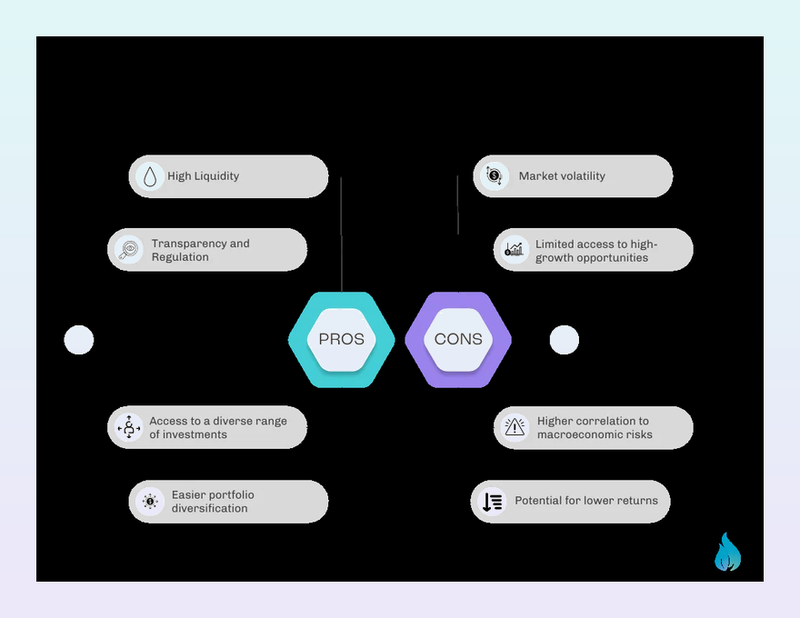
What Counts as Public Investing?
Public investing generally means buying securities — stocks, ETFs, mutual funds, bonds — of companies or funds that are registered with the SEC and trade on a recognized public market such as the NYSE or Nasdaq. These companies are required to file periodic reports (like the 10-K annual report, 10-Q quarterly report, and 8-K current report) that disclose financial performance, material events, and governance information on an ongoing basis.
Because these filings are standardized and public, investors can compare companies against each other using a shared, familiar framework — even if the sheer volume of information can be overwhelming on its own.
Investor.gov describes public companies as companies with public reporting obligations, and notes that public-company information is generally easier for investors to obtain than private-company information.
What Counts as Private Investing?
Private investing generally means buying securities of a company that has not registered that specific offering with the SEC for public trading. Instead, the company relies on an exemption — such as Regulation D, Regulation A, or Regulation Crowdfunding — that allows it to raise capital without going through full public registration.
Private companies are not required to file the same ongoing public reports as public companies. Depending on the exemption used, investors might receive a private placement memorandum, an offering circular, Form C disclosures, a data room, or simply whatever the company chooses to share directly.
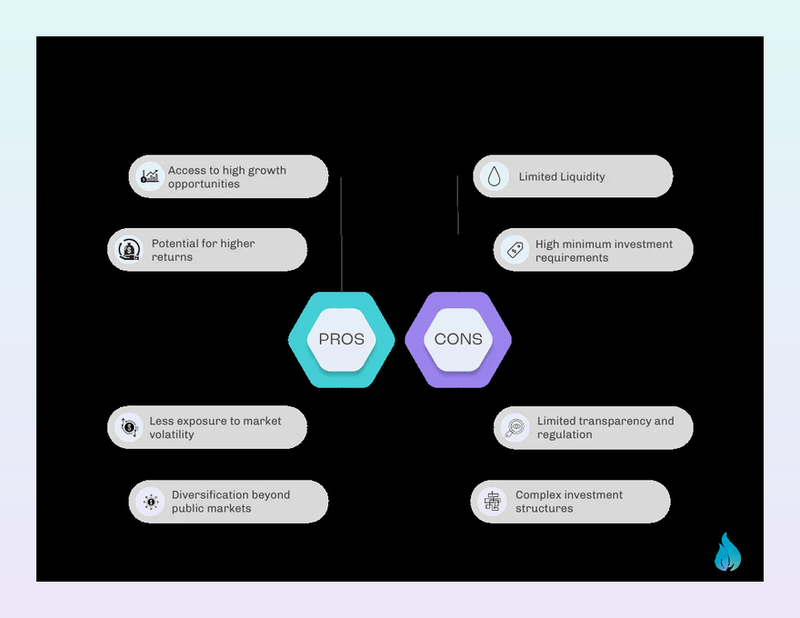
Public = registered, standardized disclosure, market-priced, generally liquid. Private = exemption-based, more variable disclosure, negotiated pricing, generally illiquid. Nearly everything else in this guide flows from that one distinction.
Public vs Private Investing: Side-by-Side Comparison
| Dimension | Public Investing | Private Investing |
|---|---|---|
| Registration | SEC-registered offering | Relies on an exemption (Reg D, Reg A, Reg CF) |
| Disclosure | Standardized 10-K / 10-Q / 8-K filings | Varies — Form C, offering circular, PPM, or data room |
| Pricing | Continuous, market-determined | Negotiated at each financing round |
| Liquidity Biggest gap | Generally high — sell during market hours | Generally low — restricted, uncertain exit paths |
| Who can invest | Anyone with a brokerage account | Depends on exemption — often accredited-only, or Reg CF limits |
| Typical stage | Established, reporting companies | Often earlier-stage, higher uncertainty |
Where Startup Investing Fits
Startup investing sits almost entirely on the private side of this comparison. A startup raising through Reg CF, Reg D, or Regulation A is, by definition, using an exemption from full public registration — which means the disclosure, pricing, and liquidity dynamics described above all apply. Understanding which exemption a specific offering relies on tells you a great deal about who can invest, what you'll be told, and what protections apply.
Who Can Invest in Private Startups?
Access depends entirely on which exemption the company is using. Reg CF offerings are open to the general public, subject to investment limits. Most Reg D offerings are limited to accredited investors. Regulation A sits in between, with different investor limits depending on the tier and accreditation status.
| Exemption | Who Can Generally Invest | Key Constraint |
|---|---|---|
| Reg CF Open to the public | Accredited and non-accredited investors | Annual investment limits based on income/net worth |
| Reg D (Rule 506) | Primarily accredited investors | Issuer must take reasonable steps to verify status |
| Regulation A — Tier 1 | Public, up to $20M raised in 12 months | Fewer ongoing reporting requirements |
| Regulation A — Tier 2 | Public, up to $75M raised in 12 months | Non-accredited investors generally capped at 10% of income/net worth |
Accredited Investor Rules in 2026
Accredited investor status is one of the most important gatekeeping concepts in private markets. It generally requires meeting one of several tests: income over $200,000 individually (or $300,000 jointly with a spouse) in each of the prior two years with a reasonable expectation of the same in the current year; net worth over $1 million excluding the value of a primary residence; or certain professional certifications, licenses, or knowledgeable-employee status at a private fund.
For most Reg D offerings relying on Rule 506(c), the issuer must take reasonable steps to verify accredited status rather than simply accepting a self-certification.
A Form D filing is a notice filing. It does not mean the SEC has approved the company, reviewed the merits of the investment, or endorsed the offering.
Investor.gov's updated bulletin emphasizes three practical private-placement risks: the possibility of a total loss, illiquidity, and more limited disclosure than investors receive in a registered public offering. Those are not fine-print concerns — they are the foundation of the decision. Always confirm current accredited investor thresholds directly on the SEC's accredited investor resource, since figures can be updated.
Reg CF: Private Startup Investing Open to the Public
Regulation Crowdfunding is the exemption most responsible for making private startup investing feel accessible in 2026. It allows eligible companies to raise capital from the general public — accredited and non-accredited investors alike — through SEC-registered intermediaries, subject to an overall offering cap and individual investor limits tied to income and net worth.
Because non-accredited investors are eligible, Reg CF is often the first (and sometimes only) way an everyday investor gains legal access to startup equity. That accessibility is exactly why understanding its disclosure requirements, limits, and risks matters — Reg CF lowers the access barrier, not the underlying investment risk.
Our own Reg CF Explained guide breaks down the mechanics — offering limits, Form C disclosures, and the investor experience — in more depth.
See the SEC's current Regulation Crowdfunding guidance for issuers for the authoritative source on offering limits and requirements.
📘 Read This FirstWhat Is Equity Crowdfunding and How Does It Work in 2026?
For the fuller picture of how equity crowdfunding platforms operate, this companion guide on the Boostfunders blog network pairs directly with the Reg CF breakdown above.
Read the complete guide on boostfunders.com →Reg D: The Traditional Private-Placement Route
Regulation D is the long-standing private-placement exemption most commonly associated with venture and angel investing. Rule 506 offerings under Reg D allow companies to raise unlimited capital without SEC registration, but most rely on selling primarily or exclusively to accredited investors, and the issuer must verify that status for certain offering types.
Reg D investors typically receive less standardized disclosure than public-market investors — often a private placement memorandum, financial statements, a data room, or a direct pitch — and the exact package can vary significantly from one company to the next.
Regulation A: The Important Middle Ground
Regulation A is useful because it shows why "public vs private" is not always a clean binary. It's an exemption from full SEC registration, but it still permits public offerings. Tier 1 allows offerings up to $20 million in a 12-month period; Tier 2 allows up to $75 million.
Tier 2 requires audited financial statements and ongoing annual, semiannual, and current reports. Non-accredited investors in a Tier 2 offering generally face a 10% investment limit based on the greater of income or net worth, unless the securities will be listed on a national securities exchange after qualification.
A security can be offered publicly without automatically becoming a liquid, exchange-traded stock. Always separate three questions: Is the offering public? Is the company a reporting company? Are the securities actually listed and liquid?
See the SEC's Regulation A guidance for the exact Tier 1/Tier 2 limits and reporting requirements.
Liquidity: The Difference Investors Feel Most
If you remember only one practical distinction, make it liquidity. Public-market investors are accustomed to clicking "sell" and seeing cash settle into a brokerage account. Private investors may have no comparable exit button — startup securities can be restricted by federal law, contractual transfer restrictions, company rights of first refusal, platform rules, or simply the absence of buyers.
- Acquisition: a buyer acquires the company and eligible shareholders receive cash, buyer shares, or another form of consideration
- Potential IPO: the company becomes public and, subject to lockups and restrictions, investors may eventually gain public-market liquidity
- Tender offer or company repurchase: the company or a third party offers to buy shares from eligible holders
- Private secondary sale: an investor finds a permitted buyer and completes a transfer under an available exemption and any company restrictions
- No exit: the company can remain private indefinitely, or fail before any liquidity event occurs
The SEC's startup liquidity resource explains that private-company securities are often illiquid, and discusses IPOs, acquisitions, and secondary transactions as possible exit paths.
Disclosure and Information: What You Can Actually Verify
Public investing gives investors a relatively standardized research process — 10-K, 10-Q, and 8-K filings, several years of comparable statements, insider transactions, and proxy materials. Private-company information is more fragmented: Reg CF investors receive Form C disclosures, Regulation A investors receive an offering circular and tier-dependent ongoing reports, and Regulation D investors may receive anything from a full data room to a simple pitch deck.
| Area to Verify | Public Company | Private Startup |
|---|---|---|
| Financial history | 10-K / 10-Q / audited annual statements | Form C, reviewed/audited statements where required, issuer-provided financials, data room |
| Ownership / dilution | Public filings and market data | Cap table, SAFEs/notes, option pool, outstanding preferred rights |
| Material events | 8-K and other filings | Updates, direct disclosure, offering amendments, company communications |
| Valuation | Market capitalization based on traded price | Negotiated pre-money/post-money valuation, cap, discount, or security terms |
| Management background | Public biographies, filings, news, governance records | Founder history, references, background checks, direct diligence |
"The company sent me a deck" is not due diligence. A good process asks whether the claims in the deck can be tied to bank statements, customer data, contracts, filed documents, financial statements, product evidence, or other verifiable sources.
Valuation and Pricing
Public-market pricing is transparent but not necessarily rational — a listed stock can be overpriced, underpriced, or highly volatile, but investors can see what buyers and sellers are willing to pay right now. Private startup pricing is more negotiated: a company might raise at a stated pre-money valuation, sell preferred equity at a fixed price, issue a SAFE with a valuation cap and discount, or issue debt with conversion features. That can make the headline valuation look precise when the underlying business is still very uncertain.
"This startup is valued at $20 million" does not mean the market independently verified a $20 million value. In private markets, valuation is often the negotiated price of a specific financing round, subject to the security's exact terms and investor demand.
For startup investors, valuation should be treated as one input, not a score. Ask what milestones justify the price, how much dilution could occur in future rounds, whether other securities have superior rights, and what ownership you actually receive on a fully diluted basis.
What Security Are You Actually Buying?
Two investors can both say "I invested in the startup" while holding completely different economic rights. One might own common stock. Another might hold preferred shares. A third might own a SAFE that does not become equity until a future financing or other trigger. A fourth could hold a convertible note or revenue-share instrument.
| Security | What It Generally Represents | Questions to Ask |
|---|---|---|
| Common stock | Current equity ownership | Voting rights? Information rights? Transfer restrictions? |
| Preferred stock | Equity with negotiated preferences | Liquidation preference? Conversion rights? Dividends? Protective provisions? |
| SAFE | Contract for possible future equity on specified triggers | Valuation cap? Discount? MFN? What if no priced round occurs? |
| Convertible note | Debt that may convert into equity | Interest? Maturity? Discount? Cap? Repayment/conversion mechanics? |
| Revenue share / debt | Contractual payment or repayment rights | Payment formula? Seniority? Covenants? Default risk? |
The SEC has specifically warned crowdfunding investors that SAFEs are very different from traditional common stock and that their terms can vary. Investor.gov explains why SAFEs can differ materially from common stock — read the actual security document, not just the campaign headline.
Risk and Return: Avoid the Simplest Myth
The simple story says public markets are safer and private startups are riskier but offer higher returns. There is some truth on the risk side — early-stage companies often fail, private securities are illiquid, and information can be limited — but the return side is not guaranteed. "More risk" does not automatically create "more return." It can simply create more ways to lose money.
- Business risk: Does the product work, and is there real demand?
- Financing risk: Can the startup raise enough additional capital to reach the next milestone?
- Dilution risk: Will future rounds materially reduce your ownership?
- Execution risk: Can the team hire, build, sell, and manage cash?
- Liquidity risk: Can you sell when you need to?
- Security-terms risk: Do preferred investors, lenders, or noteholders have rights ahead of you?
- Fraud / information risk: Are the claims accurate and complete?
Dilution, Follow-On Rounds, and Investor Rights
Startup investing is rarely a one-round story. A company that succeeds often needs more capital, and each new financing can change the cap table — your percentage ownership can shrink even while the company's total value grows. That is not automatically bad; dilution can be productive when new capital increases the company's value faster than your ownership percentage falls. But investors should understand whether they have pro rata rights, whether an SPV or nominee structure affects voting, what option pool expansion could do, and whether future preferred investors can negotiate senior rights.
For early-stage investments, cap table structure can matter as much as the headline valuation. Ask what sits ahead of your security in a sale or liquidation, and model what happens after one or two realistic future rounds.
How Private Secondary Markets Change the Picture
Private secondary markets are one of the reasons the old public/private distinction feels less absolute in 2026. Employees, early investors, funds, and other holders may be able to sell private-company shares in approved secondary transactions before an IPO. But "there is a secondary market" is not the same as "there is liquidity" — transfers can still be restricted, buyers may be limited, the company may need to consent, price discovery can be uneven, and the market may disappear when sentiment changes.
The SEC's private secondary market guidance makes this point directly: private securities are often restricted and are not freely tradeable in the way public-company securities generally are.
Due Diligence Checklist for Startup Investors
Private investing rewards curiosity. Before investing, build a written diligence checklist and force yourself to answer it from evidence rather than excitement.
| Diligence Area | Questions to Answer |
|---|---|
| Company and problem | What problem does the company solve? Who pays? How urgent is the need? |
| Traction | Revenue, users, retention, pilots, backlog, contracts — which metrics are real and verifiable? |
| Market | How large is the addressable market, and is the estimate bottom-up or a generic industry statistic? |
| Competition | What alternatives already exist, and why would customers switch? |
| Unit economics | Gross margin, acquisition cost, payback, churn, burn, runway — what matters for this model? |
| Team | What has the team built before? Are key skills missing? Are backgrounds verifiable? |
| Financials | How much cash is on hand? What is monthly burn? What assumptions drive forecasts? |
| Use of proceeds | What milestone will this round fund? What happens if less than planned is raised? |
| Security | What exactly are you buying? What rights, preferences, or conversion terms apply? |
| Cap table | What other shares, SAFEs, notes, options, warrants, and preferred rights exist? |
| Valuation | What evidence supports the price, and how does it compare with traction and comparable financings? |
| Exit | What realistic liquidity paths exist? Any reason to expect an acquisition, IPO, or secondary market? |
| Conflicts & compensation | Who is being paid to promote, sell, or recommend the investment? |
| Regulatory record | What has been filed on EDGAR? Is the intermediary properly registered? Any disciplinary issues? |
| Downside | What would make the company fail, and can you afford a complete loss? |
Red Flags to Take Seriously
A polished campaign page can make a weak deal look professional. The better your eye for red flags, the less likely presentation quality is to substitute for evidence.
- Guaranteed or near-guaranteed returns — startups are risky; promises that minimize or erase that risk deserve skepticism
- "SEC approved" language — the SEC does not approve the merits of private placements simply because a filing exists
- Pressure to act immediately — scarcity can be legitimate, but high-pressure tactics are also common in fraud
- Unclear use of funds — "marketing and growth" is not enough if the company can't explain how capital translates into measurable milestones
- Inconsistent metrics — numbers that change across the pitch deck, campaign page, interview, and filings should be reconciled
- Founder history that can't be verified — resume claims, partnerships, customer logos, and prior exits should withstand basic checks
- Pre-IPO access with vague ownership — FINRA's 2026 report specifically flags risks around pre-IPO funds, including cases where firms failed to confirm access to the shares they claimed to hold
- Complex security with simple marketing — if the terms take 20 pages to explain but the ad says "own the next unicorn," slow down and read the documents
See FINRA's 2026 Annual Regulatory Oversight Report for the full discussion of private-placement due diligence and pre-IPO fund risks.
How Public and Private Investments Can Fit in One Portfolio
Public and private investments don't have to compete for one winner — they can serve different purposes, provided the investor understands concentration, liquidity, time horizon, and loss capacity. Public markets make diversification easier, since broad funds can spread exposure across hundreds or thousands of securities and investors can usually rebalance. Private startup portfolios are harder to diversify because each investment requires more diligence, the capital is locked up, and outcomes can be highly skewed.
For that reason, private startup investing is often treated as a higher-risk, long-duration allocation rather than a substitute for emergency savings, near-term goals, or a diversified core portfolio. The exact allocation is personal and should reflect the investor's circumstances — this article does not recommend a percentage.
Investor.gov's 2026 tips emphasize diversification and matching asset allocation to risk tolerance and investing timeframe.
A Practical Decision Framework
Before choosing between a listed stock and a private startup opportunity, walk through the same questions every time. This prevents the story around the investment from deciding for you.
| Question | If Your Answer Is "Yes"… | Why It Matters |
|---|---|---|
| Could I need this money in the next several years? | Public/liquid investments may fit better than illiquid startup securities | Private exits are uncertain |
| Can I tolerate a total loss? | You may have the loss capacity for speculative private investing | Startup failure risk is real |
| Do I understand the exact security? | Proceed to evaluate valuation and company quality | Security terms drive economic rights |
| Can I verify the company's claims? | Your diligence has a stronger evidence base | Private disclosure can be limited |
| Am I investing because of FOMO? | Pause before committing | Urgency is not diligence |
| Is this one of many investments or a concentrated bet? | Diversified exposure reduces single-company dependence | Startup outcomes are highly uneven |
| Do I understand how and when I might exit? | You're thinking like a long-term private investor | Liquidity can matter more than paper gains |
If you cannot explain how you might lose money, you probably do not understand the investment well enough yet.
What Founders Should Understand About Investor Expectations
This article is written for investors, but the comparison matters for founders too. A founder raising from the public under Reg CF is competing for attention with public-market investments that offer investors easier research and liquidity — which means the startup has to work harder to earn trust. Private investors want a clear reason to accept the trade-offs: why the company is raising now, what milestone the money will fund, what evidence supports the opportunity, what security they receive, and what risks could derail the plan.
Good fundraising marketing does not hide those trade-offs — it organizes the facts so investors can evaluate them. That's why PledgeWire's equity crowdfunding content consistently emphasizes investor education, founder-led communication, proof, and a structured funnel rather than "hype first, details later." Our own guide to building an investor funnel covers this from the founder's side in depth, and our equity crowdfunding marketing strategies guide shows how campaign messaging, traction, and social proof are deliberately built around investor trust.
📘 Boostfunders · Related ReadingHow Wefunder Works: A Founder's Complete Guide
Boostfunders explains how Wefunder and Reg CF let startups raise from accredited and non-accredited investors while still requiring founders to bring traction, audience, and investor trust.
Read the complete founder's guide on boostfunders.com →What Changes in 2026 — and What Does Not
The most important 2026 change is not one dramatic new rule. It's the continued normalization of private-market access. Equity crowdfunding is established, online private placements are easier to discover, and private secondary transactions are a larger part of the conversation around startup liquidity.
At the same time, the fundamentals have barely moved. Private startup investing is still speculative. Liquidity is still uncertain. Due diligence still matters. "Pre-IPO" is still not a synonym for "guaranteed upside." Public-company disclosure remains easier to access and compare. Accredited-investor rules still determine access to many private placements.
The SEC's Regulation D statistics page was updated in June 2026, its accredited-investor guidance in April 2026, and FINRA's 2026 oversight report continues to focus on private-placement supervision and due diligence. The direction is clear: private markets are important and increasingly visible, but investor protection still depends heavily on understanding the structure and doing the work.
Current SEC data: the SEC's Regulation D statistics and data visualization page was updated June 30, 2026.
Conclusion: Access Is Broader, but the Trade-Offs Are Still Real
Public investing and private investing are not simply two versions of the same experience. Public markets usually give investors better standardized disclosure, visible price discovery, and more flexible liquidity. Private startup investing can give investors access to companies earlier in their life cycle, but that access comes with more uncertainty, more dependence on deal terms, and a much less predictable exit.
The rise of Reg CF and other online investment channels has made private investing feel more familiar. That's good for access, but it makes investor education more important, not less. A private startup can now appear in the same browser where you check your brokerage account, while still carrying a completely different risk profile.
In 2026, the investors who are best prepared are not the ones who automatically prefer public or private markets. They're the ones who know which rules apply, read the documents, understand the security, test the valuation against evidence, plan for illiquidity, and size the risk so one company cannot determine their financial future.
Frequently Asked Questions