Wefunder is a strong starting point for founders raising from an existing community. StartEngine deserves consideration when fundraising services and a possible Reg A offering matter. Republic is worth considering when your business fits its selection process and investor audience.
For investors, the answer depends more on the company, security, valuation, and total costs than on the platform's name. A good website cannot turn an unsuitable investment into a good one.
This comparison explains where each platform may fit, what the published fees actually cover, and which questions to ask before raising or investing money.
This guide focuses on U.S. equity crowdfunding, particularly Regulation Crowdfunding (Reg CF). Private funds, accredited-only deals, and Republic Europe can have different rules and pricing. Sources checked September 8, 2026. Recommendations are editorial judgments based on the cited features, not rankings of investment performance or personal investment advice.
Key Takeaways
- Founders: Compare the money your business keeps, the securities you issue, the services included, and your ability to reach suitable investors
- Investors: Compare the actual offering and its fees. Minimum investments, rights, and eligibility vary
- Wefunder: Its public community-round pricing is distinct from its private-round products
- StartEngine: Obtain a current itemized quote; its published disclosures describe multiple fees and service arrangements
- Republic: Its standard Reg CF issuer commission includes both cash and securities
- All three: Platform access and resale features do not guarantee funding, a buyer, or positive returns
Wefunder vs StartEngine vs Republic at a Glance
The following shortlist reflects practical fit. It does not mean that one platform is automatically better for every company in a category.
| Platform | Strong Reason to Shortlist It | Main Issue to Examine |
|---|---|---|
| Wefunder | Raising from customers, supporters, angels, and your existing network | Whether you have enough investor interest to support the round |
| StartEngine | Comparing Reg CF and Reg A fundraising services | The full quote, including additional services and securities compensation |
| Republic | Applying to a platform with a stated startup selection process | Acceptance, audience fit, and the economics of the specific offering |
Basis: Wefunder's founder positioning, StartEngine's Reg CF and Reg A explanation, and Republic's selection process. The shortlist is our interpretation of those features.
An investor can research offerings across all three. There is little value in choosing a permanent favorite before seeing which businesses are available and what rights their securities provide.
Compare the Same Type of Fundraising First
These brands offer more than one product. Comparing Wefunder's public community round with an accredited-only private fund or a Republic Europe investment can produce misleading conclusions about fees and access.
Under SEC Regulation Crowdfunding guidance, eligible companies can raise up to $5 million in a 12-month period. Non-accredited investors can participate, subject to aggregate investment limits. Required disclosures and an SEC-registered intermediary are part of the framework.
Regulation A is a different route. The SEC's Regulation A overview describes offerings of up to $20 million under Tier 1 and $75 million under Tier 2, with different requirements. A larger permitted raise does not mean a founder should choose it before considering preparation costs and realistic demand.
Start with four questions: Which legal exemption is being used? Which platform entity handles the offering? Who can invest? What security will investors receive?
For the founder requirements behind a public community round, read PledgeWire's Reg CF explained guide.
When Wefunder May Be the Best Fit
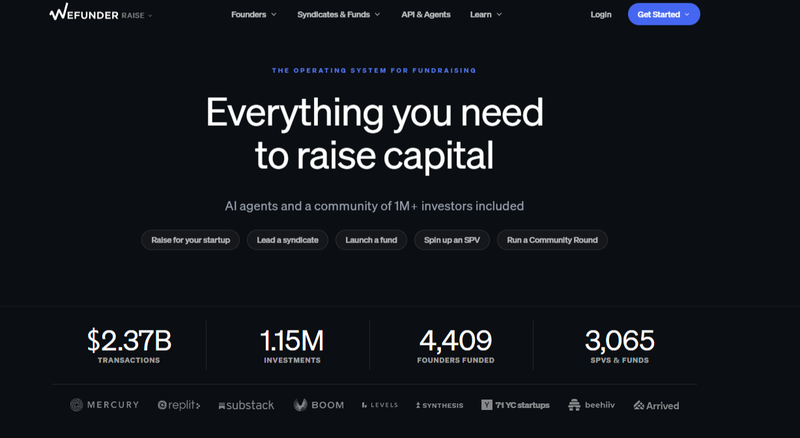
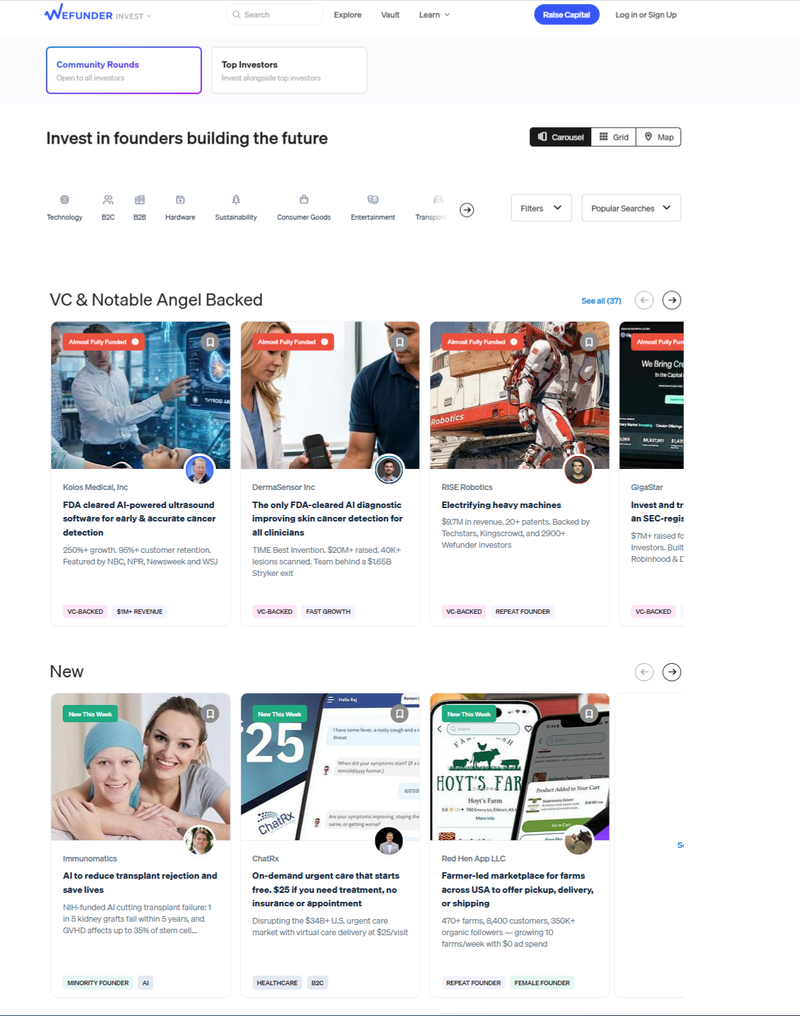
Wefunder's own founder materials emphasize raising from people who already know or believe in the business, including customers, users, angels, and the founder's network. That makes it a sensible first conversation for a company with an engaged community.
Imagine a software business whose customers regularly recommend the product, attend founder events, and ask how they can support its growth. A public investment round gives that interest a structured destination. The founder still needs credible terms and a clear explanation of what the capital will achieve.
Why shortlist it: Your strongest fundraising asset is a group of people who understand the business and want to participate in its progress.
What to question: How much genuine investment interest exists? Product enthusiasm and social followers are useful starting points, but neither is a completed investment. Ask what campaign tools, communications support, and ongoing administration your particular arrangement includes.
Wefunder also offers private rounds and investment vehicles. Its private-round pricing explanation describes different charges and circumstances in which invited investors receive fee waivers. Those terms should not be substituted for the public Reg CF fee schedule.
For the application-to-launch process, see Boostfunders' guide to how Wefunder works.
When StartEngine May Be the Best Fit
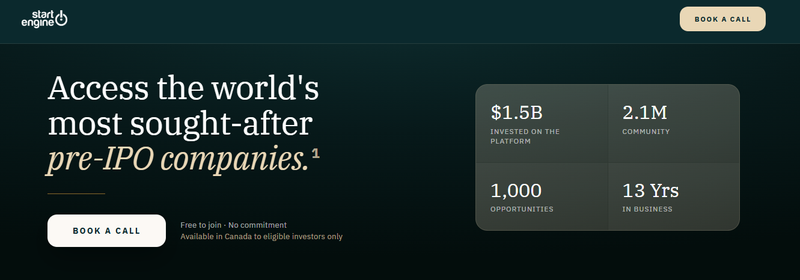
StartEngine deserves a place on the shortlist when a founder wants to compare a public Reg CF raise with a possible Reg A offering and understand the services available around those routes.
Its Reg CF and Reg A guide distinguishes the two frameworks. Its corporate reporting also describes issuer consulting and transfer-agent services. Availability, responsibilities, and pricing need to be confirmed in the proposal for your business.
Why shortlist it: You have a defined fundraising plan and want to assess the platform's offering support, investor experience, and administration alongside its distribution opportunities.
What to question: Which services are included in the base fee? Which are separately priced? Who owns the campaign work, and what happens after closing? A package is valuable only if it solves work your team actually needs help completing.
For example, a founder preparing a substantial public raise may value help coordinating documents and shareholder administration. Another founder with experienced advisers may need fewer services. They should not judge value from the same headline percentage.
For investors, StartEngine's marketplace features are a reason to investigate the details of resale access. They are not evidence that every investment bought on the platform can later be sold.
When Republic May Be the Best Fit
Republic describes a startup selection process that considers founders, product, traction, mission, and further diligence. That can make it an appropriate platform to approach when a company has a clear business case and evidence supporting its progress.
Why shortlist it: You can explain why your business fits the platform's selection criteria and why its investment proposition would interest the audience you want to reach.
What to question: What milestones or evidence are needed for acceptance? Which security structure is appropriate? What distribution support is included after approval? Being accepted is only one stage in raising capital.
Republic also presents a broader range of private investment categories, including startups and other assets. Investors should check whether a listing provides company equity, a future-equity contract, a fund interest, or something else. Opportunities appearing under the same brand may have very different economics.
A selection process can help organize what reaches a platform. It should not be treated as an independent guarantee of business quality, valuation fairness, or future returns. The investor still needs to assess the company and read the offering documents.
Founder Fees: Compare the Total Cost of the Raise
Platform commission is only one part of fundraising cost. The comparison below concerns published U.S. issuer pricing and disclosures; a signed agreement determines the charges for an actual campaign.
| Platform | Published Issuer Fee Information | Additional Items to Clarify |
|---|---|---|
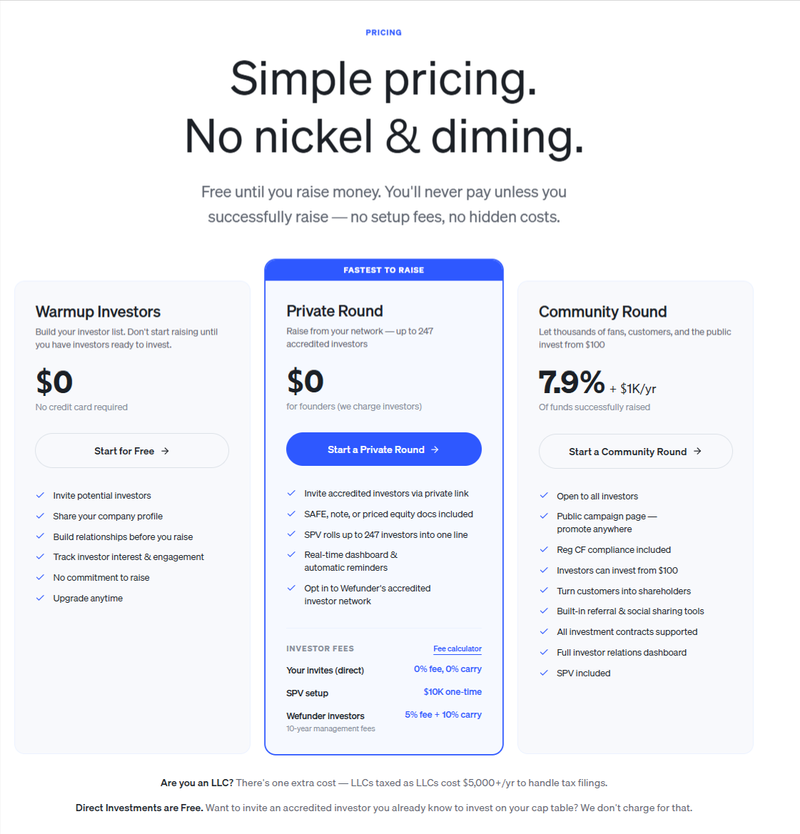
| Wefunder | Reg CF success fee: 7.9% of funds raised | Annual administration: lesser of $1,000 or 0.5% raised; LLC tax circumstances may alter it |
| StartEngine | Q1 2026 filing describes typical Reg CF commissions of 6%–10% | Cash versus securities compensation, consulting, transfer-agent services, and other charges |
| Republic | Standard successful financing: 7% of funds raised plus 2% of securities offered | Legal, financial, escrow, processing, and other campaign costs |
Sources: Wefunder's public Reg CF fee schedule, StartEngine's March 31, 2026 quarterly filing, and Republic's issuer commission page. These are not like-for-like all-in quotes.
Understand Cash Fees and Securities Fees Separately
A cash fee reduces the proceeds available to operate the business. Securities compensation gives the recipient an investment interest under the agreed terms.
Republic's stated 2% securities component should not be casually described as 2% of your entire company. The published wording refers to securities offered in the financing. Ask how the agreement calculates that amount and how it affects your capitalization table.
StartEngine's separate compensation disclosure also describes securities-based compensation and additional charges. Confirm the relevant intermediary and product before using any advertised percentage in your budget.
A Simple $500,000 Example
For a hypothetical successful $500,000 raise, Wefunder's 7.9% headline commission is $39,500. Republic's 7% cash commission is $35,000, alongside its securities component. The $4,500 cash difference does not establish which option costs less overall.
You still need to account for preparation, professional fees, marketing, payment processing, administration, and the economic effect of securities compensation. Republic's campaign-cost guidance illustrates several categories beyond commission; obtain current vendor quotes rather than assuming its example costs will match your business.
Ask each platform for the same breakdown: costs before launch, deductions at closing, securities issued as compensation, recurring costs, and charges if the campaign is cancelled or fails. Then compare expected usable proceeds at a conservative fundraising amount as well as your target.
Investor Fees and Minimum Investments
Investor fees deserve their own comparison because they can be paid in addition to the amount invested in the company.
| Platform / Payment Method | Published Transaction Charge | Fee on a $1,000 Investment |
|---|---|---|
| Wefunder: ACH or wire | 2%; $8 minimum; $150 maximum | $20 |
| Wefunder: card, Apple Pay, or Google Pay | 5.5% + $2; $8 minimum; no maximum | $57 |
| StartEngine | A 3.5% investor fee may apply, depending on the offering | $35 if applicable |
| Republic | Typically 2.5%; $5 minimum; $250 maximum; offering exceptions apply | $25 at the standard rate |
Sources: Wefunder investor fees, StartEngine's Reg CF investor education guide, and Republic investor fees. Examples exclude discounts, bank or currency-conversion charges, and any separate vehicle or performance fees.
At these rates, a $1,000 investment would require $1,020 through Wefunder ACH, $1,057 through Wefunder card payment, $1,035 where StartEngine's fee applies, or $1,025 at Republic's standard rate. These examples compare transaction costs, not investment quality.
Minimum fees matter more on small purchases. Wefunder's $8 minimum on an eligible $100 ACH investment is an 8% transaction charge. That does not mean buying more is appropriate; it means the fee should be visible in your decision.
There Is No Universal Minimum Across the Three Platforms
Wefunder's terms describe offering minimums generally starting at $100. Republic's minimum-investment FAQ says minimums vary and can be as low as $150. StartEngine's campaign-page guide identifies the minimum investment among the offering-specific terms to review.
An issuer can require more. Private funds and other products may also use substantially different minimums.
Review the final payment amount, cancellation treatment, and any management fee or carried interest. Carried interest means a share of profits payable under the investment arrangement. A transaction-fee table cannot summarize every charge associated with every product on these platforms.
Deal Quality and Ownership Matter More Than the Logo
The security determines what an investor owns. Read the agreement alongside the pitch:
- Shares — Check the share class, valuation, voting rights, dilution, and who gets paid first in an exit
- A SAFE — A simple agreement for future equity is not the same as owning shares immediately. Conversion depends on its terms and triggering events
- A fund or vehicle interest — Identify the entity you own, its underlying investment, who controls decisions, and any extra fees
- Debt or another contract — Examine repayment obligations and financial capacity rather than assuming the economics resemble ordinary equity
The SEC's bulletin on SAFEs explains why future-equity contracts require particular care.
Then assess the business: revenue quality, cash runway, customer concentration, competition, use of proceeds, founder incentives, and the assumptions behind the valuation. A popular campaign can still be expensive relative to its prospects.
Registration is a separate check. FINRA's funding-portal directory lists Wefunder Portal LLC, StartEngine Capital LLC, and OpenDeal Portal LLC, which uses the Republic name. Other products can involve different entities. Registration does not mean an investment is government-approved or protected against loss.
The SEC's crowdfunding investor bulletin discusses total-loss risk and illiquidity. Neither platform screening nor an attractive campaign page removes those risks.
Which Platform Offers Better Resale Access?
Resale features are useful only when they apply to your security and you can find a buyer.
Wefunder: Its transfer guidance explains help with eligible transfers, with different handling for direct and custodian or vehicle investments. Administrative help does not establish a continuous trading market.
StartEngine: It offers Marketplace features, including StartEngine Secondary. Its marketplace explanation distinguishes trading mechanisms and eligible securities. Its trader-eligibility guidance also describes restrictions, including on international investors.
Republic: Its secondary-market eligibility page describes sell requests for eligible SAFEs from companies that previously raised on Republic, subject to issuer approval. That is narrower than assuming every Republic investment can be traded.
For U.S. Reg CF securities, a one-year transfer restriction generally applies, with exceptions. Passing the anniversary does not create liquidity or eliminate contractual and other legal requirements.
Ask about your specific holding: Is it eligible today? Who must approve a sale? What restrictions and charges apply? Is there actual buyer interest? Do not choose an investment on the assumption that a future marketplace listing will happen.
International Eligibility Can Change the Answer
Being able to view a campaign is different from being allowed to invest. Country, residence, investor status, platform policy, and issuer restrictions can all matter.
Current published examples show why a generic "open worldwide" claim is unreliable:
- Wefunder — Its terms, updated August 13, 2026, exclude investment participation by persons or entities located in, incorporated in, or resident in Canada
- StartEngine — Its international-investor FAQ lists restricted countries, including Canada, and describes a UK exception for accredited investors
- Republic — Its Canadian-investor guidance describes conditional participation and restrictions affecting Ontario and British Columbia
These examples are not complete eligibility lists. Readers in the UK, Canada, Europe, Nigeria, or elsewhere should confirm the current rules for their location and the actual offering. Republic Europe also operates under a different framework from the U.S. service compared here.
For founders, verify who can legally participate before spending money promoting the round to that audience. Under the SEC's issuer guidance, non-U.S. companies are not eligible for Reg CF. An international founder's personal location and the issuing company's legal eligibility are separate questions.
Marketing, Launch Support, and Life After the Raise
A platform provides the place where an offering can be reviewed and an investment processed. Founders still need a convincing business case and a plan to reach interested investors.
During platform discussions, ask for specific deliverables:
- 1.Which promotional placements are included, and which are paid, discretionary, or unavailable?
- 2.Who prepares campaign materials and answers investor questions?
- 3.What information and analytics can your team access?
- 4.How are interest, investment commitments, cancellations, and completed funding distinguished?
- 5.Who manages shareholder records, investor updates, and administrative support after closing?
Ask for comparable campaign references with similar stage, sector, target, and existing audience. A large platform user count does not tell you how many suitable investors will see your offering.
PledgeWire's investor-funnel guide explains how audience building, education, evaluation, and investment completion connect. The platform decision should support that process.
Set a realistic launch schedule around financial statements, legal documents, platform review, and audience preparation. A fast account setup does not mean the offering is ready to close.
After a Reg CF raise, ongoing annual reporting generally continues until an applicable termination condition is satisfied. Include that work in the operating budget. Founders seeking support with positioning, email, campaign content, or paid promotion can review Boostfunders' equity crowdfunding marketing service, alongside the requirements set by their platform and legal advisers.
How to Make the Final Decision
For Founders
Use the same short brief when speaking to each platform: business stage, target and minimum raise, current audience, early investor interest, proposed security, available budget, and timeline.
Then rank the responses against five practical factors: eligibility and acceptance, audience fit, total cost, service scope, and ongoing administration. Treat an unresolved legal or operational requirement as a reason to pause that option, even if its marketing presentation is impressive.
Our suggested starting points are:
- Start with Wefunder when customers, users, and existing relationships are central to the raise
- Compare StartEngine closely when its fundraising routes and service proposal match the work you need done
- Approach Republic when your company has a strong case for its selection process and a clear fit with the investors you want to reach
For example, a founder with an engaged customer community and limited need for additional services may prioritize different things from a company preparing a larger, more complex public offering. The right choice follows the business's needs.
For Investors
Research relevant offerings across platforms. Set an amount you can afford to put at risk, assess the business and security, and then compare total fees and practical access.
Treat a bonus-share promotion as a pricing detail. It does not establish that the underlying valuation is attractive. Likewise, a successful fundraising campaign has met a financing milestone; it has not necessarily produced returns for investors.
This guide does not name a winner for investor returns. The cited materials do not provide a matched, complete comparison of realized investor outcomes across all three platforms. A credible comparison would need consistent investment periods, failures, fees, unrealized holdings, and actual distributions.
📘 Read This FirstReg CF Explained: What Founders Must Know Before Raising Equity
Understand the disclosure and compliance framework behind the Reg CF offerings run on all three platforms compared here.
Read the full guide →Conclusion
Wefunder, StartEngine, and Republic can each make sense for different reasons. Founders should choose around investor fit, total cost, and the work required to run the raise. Investors should choose the business and security on their merits, then assess the platform's fees and restrictions.
The most useful next step is to compare a specific proposal or offering against your needs. A platform's reputation is a starting point for that review, not its conclusion.
Frequently Asked Questions