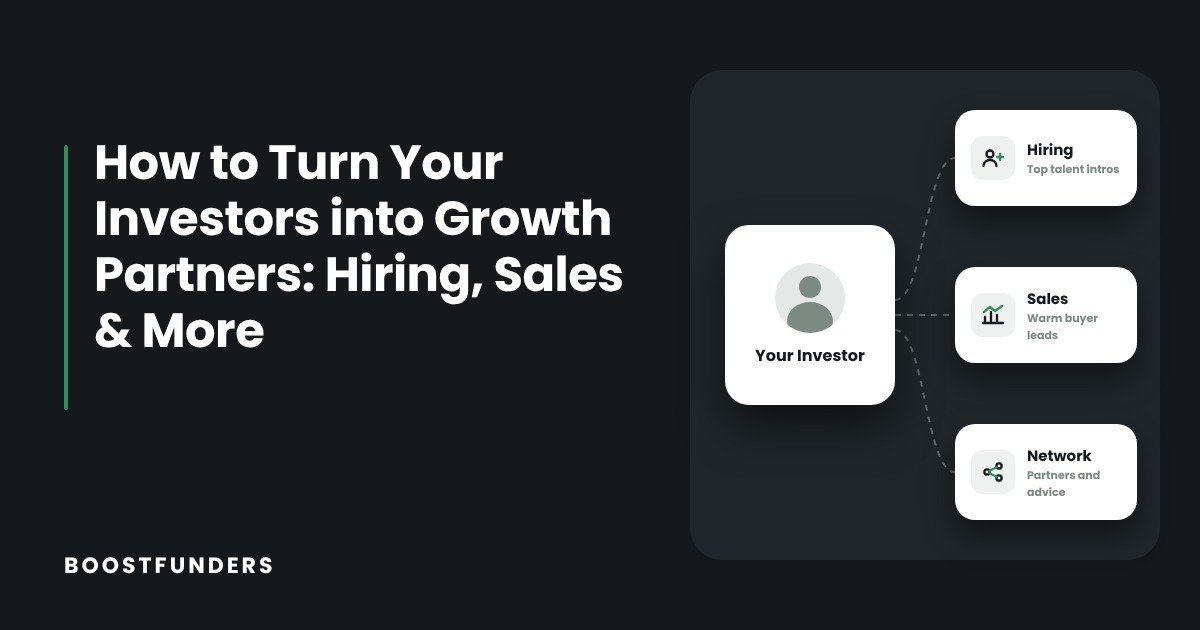
Turn investors into growth partners by matching their real strengths to a small number of business priorities. Give each request a clear outcome, the right context, a sensible deadline and an owner inside your company. Keep investors informed, make introductions easy to act on, and report back on what happened.
Your round has closed. The money is in the account, new names are on the cap table, and several investors have said, "Let me know how I can help." Then the operating work starts again. You need to hire someone important, reach a hard-to-get customer, make a pricing call and prepare for the next stage, while the investors who seemed so well connected during fundraising receive updates but little practical help happens.
That gap is usually a coordination problem, not a lack of goodwill. Investors may have useful experience or relationships without knowing which problem matters most, what you've already tried, or exactly what you want them to do. This guide shows how to organize their support across hiring, sales, partnerships, product, marketing, operations and future fundraising, and how to set boundaries so helpful involvement doesn't turn into confusion or unwanted control.
Educational note
This is general business guidance, not legal advice. Investor rights and company obligations depend on your agreements and the law that applies to you. U.S. rules are named where relevant. Templates and numbers are original illustrations, not client results. Sources checked October 31, 2026.
Key Takeaways
- Match each investor's proven expertise and available time to a specific company need.
- Keep voluntary help separate from board duties, contractual rights and paid advisory work.
- Ask for a defined action: an introduction, a candidate review, a decision discussion or a specialist referral.
- Your team, not the investor, owns the follow-up on every introduction.
- Send consistent updates with progress, problems and one or two clear asks.
- Protect confidential information and coordinate investor help with your existing processes.
- Measure outcomes honestly. An introduction doesn't guarantee a hire, a sale or an investment.
1. Define What a Growth Partner Actually Does
A growth partner helps the company make progress on an operating priority. That might mean opening the right door, improving a decision, removing avoidable work, or helping you see a problem more clearly. It doesn't need to be dramatic. One well-timed introduction to a strong candidate can matter, and so can a frank conversation that stops you hiring the wrong executive or signing a poor distribution deal.
Useful involvement, not constant involvement
More investor activity doesn't automatically help. Ten loosely relevant introductions can create more work than one well-chosen conversation. The question to ask is: what changed because the investor helped? Did a qualified prospect enter the pipeline? Did the team understand the role it needed to fill? Did a decision improve because someone spotted an assumption you'd missed? Start with the company's priorities and work backward to the investor's contribution.
Investors offer different kinds of support
An angel who built a sales team may give personal guidance. A larger fund may have recruiting, marketing or finance specialists. A customer who invested may understand product use better than either. Some firms run formal platforms; a16z's portfolio jobs board, for example, lists open roles across its portfolio companies. That's one firm's model, not something every investor provides. Ask what your investor actually offers, who delivers it, how requests should reach them and how much time is realistic.
2. Separate Ownership, Governance, Advice and Execution
One person can hold several roles, but each role should stay clear. An investment alone doesn't create a commitment to recruit your staff, sell your product or work a set number of hours.
| Role | What it means | Where it's defined |
|---|---|---|
| Investor | Holds the rights attached to the investment | Investment and shareholder agreements |
| Director | Takes part in formal governance and approvals | Board documents and company law |
| Informal adviser | Offers judgment when asked | A shared understanding, usually unwritten |
| Consultant / operating partner | Delivers defined work | A separate, scoped agreement |
The NVCA model legal documents include investors' rights and voting agreements, which shows where some formal arrangements are written down. Check your own agreements for information, approval and governance rights.
Agree what support is voluntary
Ask how each investor prefers to help and what they can't take on. A limited but clear answer beats a vague promise to "help with growth". For example, an investor might agree to review hiring briefs when asked, make introductions where their relationships allow, and join an occasional strategy discussion. If you need regular execution, hire someone or engage a service provider; don't build a critical function on informal availability.
Keep decision authority clear
Your sales lead owns the sales process. The hiring manager owns candidate evaluation. Formal board or shareholder approvals still follow your documents and the law. When an investor offers an opinion, be clear whether it's advice, a request for information, or a matter that needs a formal decision, so a casual suggestion doesn't become an unofficial instruction to your team.
3. Map Your Investors' Strengths and Availability
Your cap table shows who invested and how much. It doesn't show who can introduce a procurement lead, review a compensation plan or explain a new market. Keep a separate working record of each investor's relevant experience, sectors, geographies, relationships they're comfortable using, preferred contact method, availability and potential conflicts, and update it through conversations.
| Investor strength | A suitable request | Internal owner |
|---|---|---|
| Recruiting experience | Review the role brief and interview plan | Hiring manager |
| Relationships with relevant buyers | Ask permission for a targeted introduction | Sales lead |
| Sector operating knowledge | Test assumptions in a market-entry decision | Founder or business lead |
| Product expertise | Review the evidence behind a product choice | Product lead |
| Finance experience | Challenge cash-plan assumptions | Finance lead |
| Communications experience | Review positioning for a defined audience | Marketing lead |
| Fundraising relationships | Identify suitable next-round investors | Founder |
| Customer or community knowledge | Join a structured product-feedback session | Research or community lead |
A matching aid, not a list of duties. Confirm willingness and scope with each investor.
Ask about recency. Someone who hired enterprise sales leaders ten years ago still has useful judgment, but their candidate network may have moved on. An investor who knows a big company's CEO may have no access to the team that would actually buy from you. And look beyond the largest cheque: a small investor may know a customer segment better than anyone, while a large fund may have a specialist team you've never met.
4. Onboard Investors After the Round
The pitch deck explained why the company deserved investment. After closing, investors need to understand how you plan to execute. Arrange a short onboarding call or send a brief operating note covering current priorities, key metrics, how you'll report, who owns what, and the kinds of help you expect to ask for.
Choose a few concrete objectives, for example: recruit the first customer-success lead, improve onboarding completion, and validate one buyer segment. Explain why each matters now. If onboarding is the real bottleneck, more prospects may add pressure without improving the business.
Agree on channels: which one for normal requests, which for urgent matters, and whether they prefer a short email, a fund's support form or a periodic working session. Name a company contact for each workstream so investors know whom to copy when they find a candidate or customer. Make it clear what can be forwarded: a short public company summary is very different from an internal financial update.
Then invite a realistic commitment: "Over the next quarter, where could your experience be most useful, and how much involvement is realistic for you?" That gives the investor room to offer help without overpromising, and stops you planning around help nobody has agreed to.
5. Turn a Broad Need Into a Request Someone Can Complete
"We need help with sales" leaves the investor to diagnose the business, find a buyer, write the pitch and decide what happens next. A strong request removes that guesswork.
Objective
What business result are we trying to achieve?
Request
What exact action would you like the investor to take?
Fit
Why is this person the right one to ask?
Context
What has the team already learned or tried?
Material
What can the investor review or forward?
Timing and owner
When is it useful, and who follows through?
Problem: no target, no action, no owner. The investor has to do all the thinking.
Why it works: a clear goal, a small bounded action, a reason for fit and a named follow-up. (Illustrative example.)
Ask for only a few things at a time; if everything is urgent, the investor can't tell where attention matters. Make it easy to decline or redirect: "If this is outside your network, a suggestion for a better route would still help." Respect a no, and stop sending tasks to someone who has explained their limits.
6. Use Investors to Improve Hiring, From Brief to Offer
Recruiting help works best once you've agreed what you need: responsibilities, expected outcomes, seniority, pay range and reporting line. A vague request for a "great marketer" can bring in people with completely different skills. A startup that needs its first hands-on demand-generation hire isn't ready for a senior leader who expects a large team and budget.
Start with the role, not the candidate
Ask an experienced investor to challenge the job brief. Does the role address the real problem? Is the scope realistic for one person? Are the outcomes right for your stage? This is especially useful for a first executive hire, where you need to tell the difference between someone who builds a function and someone who manages an established one.
Widen sourcing without lowering the bar
Ask whether the fund has a recruiting team, a talent network or a portfolio jobs page. Investor referrals should go through the same job-relevant evaluation as everyone else: interviews, work assessment and proper reference checks. A strong endorsement adds context but doesn't replace evidence. Keep sourcing beyond the investor network too, or your hiring narrows to familiar backgrounds.
Involve the investor at a defined stage
An investor might help calibrate interview questions, assess a specialist skill, or speak with a finalist about the company's direction. Tell the candidate who they are and why they're involved, share candidate information only as needed, and give the investor a specific question to answer rather than asking for a general impression. During offers, an investor can explain why they backed the company, but they shouldn't promise future funding, promotions or equity value. The founder and hiring team still own the decision.
7. Turn Investor Introductions Into a Disciplined Sales Process
An introduction creates access. Your team still has to confirm fit, understand the problem, make a credible offer and deliver. Before asking for introductions, define your target customer by industry, size, operating problem, current workflow, buyer role and why now.
The most senior contact isn't always the most useful. A CEO may pass you on, while an operations manager may feel the pain and drive the evaluation. Share a short list of target organizations or a precise buyer profile, and ask the investor to check whether the contact wants an introduction before passing on any details.
Coordinate with existing account activity
Before any introduction, check whether someone on your team is already talking to that account. Duplicate approaches make you look disorganized and put the investor in an awkward spot. Log the relationship in your CRM with a named owner, and reply within the timeframe you agreed; if you can't follow up properly, ask to delay the introduction. Never ask an investor to pressure a buyer or bypass procurement or security review. A relationship should start a legitimate conversation, not create an obligation to buy.
8. Build Partnerships With an Owner and a Commercial Purpose
Investors may introduce distributors, implementation partners, suppliers, integration partners or larger companies in your market. "Strategic partnership" isn't an objective. Write a short brief covering the customer problem, what each side contributes, what the customer gets, how the economics work, the first test and the criteria for continuing.
For distribution, ask about customer access, sales incentives, support responsibilities and channel conflict. For an integration, define technical ownership, maintenance, data handling and the demand that justifies the work. The investor can review assumptions or find the right counterpart; your team decides whether the partnership deserves engineering and commercial time.
When the investor has another interest
An investor may also back the potential partner, work for it, or benefit from the deal. Disclose and review that through your normal process. Compare the terms with alternatives, and look closely at exclusivity, pricing, ownership of improvements, termination and any restrictions that could affect a later fundraise or acquisition.
9. Use Investor Experience to Improve Product and Strategy Decisions
Investors see across many companies, but they're further from your daily customer evidence. Their advice is most useful when you give them a decision to examine. Prepare a short decision note covering the problem, options, evidence, constraints, your recommendation and the point you want challenged.
For example: "We're deciding between a self-service onboarding flow and a managed onboarding service. Here's what we know about drop-off, support time and willingness to pay. Which assumption would you test before committing the next six weeks?" That's far easier to answer than "What should our strategy be?" Match the person to the problem, too: an enterprise-procurement expert may not know much about consumer retention.
When advice conflicts, ask what evidence supports each view and what would change the recommendation, then pick a test. The Techstars Mentor Manifesto sets out principles that apply well to investor advice: give specific, actionable advice, say "I don't know" when you don't know, hold information in confidence, and remember that teams make their own decisions. Don't reset priorities after every investor call.
Investors can also open research access: a specialist, a former buyer, or an operator who has faced the same problem. Frame these honestly. A research interview shouldn't be a disguised sales pitch, and you need permission before sharing anyone's identity or comments.
10. Involve Investors in Marketing and Distribution Responsibly
Investors can help sharpen positioning, introduce journalists or partners, give a factual quote, speak at an event, or share company news. Start with the audience and message: a big following is only useful if it reaches people who care about your product. Give investors a short company description, approved product facts, a public link and the intended audience, and be clear about what's still in development.
If an investor comments publicly, the quote should reflect their actual view, with approval for the wording, name, title and use of their firm's name. A private compliment isn't a public endorsement.
Disclosure and securities rules
The FTC's endorsement guidance says connections that consumers wouldn't expect, and that could affect how they judge an endorsement, should be disclosed clearly. In our view, an investor promoting your product is a clear case for disclosing that relationship. Separately, promoting a product and inviting people to invest are different communications: the SEC's general solicitation guidance explains that what you can say depends on your offering route. Don't add an investment invitation to a product announcement without checking.
For campaign communication planning, see our equity crowdfunding marketing strategies, but keep legal approval with counsel and your platform. Track real results where you can, such as relevant visitors, qualified inquiries or customer conversations; impressions alone don't show value. If an introduction leads to a media conversation, your team handles preparation and follow-up, and nobody can promise coverage or how a journalist frames it.
11. Ask for Operational Help That Removes a Real Constraint
Investor support can also help with finance, supplier selection, international expansion, security and internal processes. Start with the problem, such as a better cash forecast, a specialist in a regulated segment, or comparing manufacturing options, not with the investor's list of favourite vendors.
An experienced operator can help you frame questions, weigh trade-offs or find good service providers. Evaluate those providers as you would any other: credentials, scope, cost, conflicts and references. An introduction isn't a quality guarantee. For legal, tax, accounting or regulatory matters, use qualified professionals; investment experience doesn't make someone your lawyer.
Check portfolio perks and credits carefully: eligibility, expiry, minimum commitments, renewal pricing and migration costs. A discount on something you don't need isn't a saving. Before entering a new market, ask for conversations with local buyers, operators and specialists, and test procurement, pricing, competition and cost to serve. An investor's enthusiasm is a hypothesis, not evidence.
12. Prepare for the Next Round Before Asking for Introductions
Existing investors can help you understand what the next round will require, identify suitable firms, review positioning and make introductions. That preparation is most useful before cash pressure becomes urgent. Discuss the milestone, capital needs and open questions, and ask them to challenge whether you're ready or whether more progress would strengthen the case. Boostfunders' Startup Fundraising Advisory covers readiness, positioning and diligence preparation.
Keep help and participation separate. An investor may make introductions without planning to invest again; another may want to participate but need internal approval or different terms. Ask directly, separate contractual participation rights from any obligation to invest, and record real commitments accurately. Never tell new investors your existing group is "fully supporting the round" if you only mean they're willing to make introductions.
Coordinate outreach from one target list, with one owner per relationship, so several investors don't approach the same fund with different stories. Give the introducing investor a current summary and the reason each target fits. Boostfunders' Investor Outreach & Lead Generation supports that research and process. For the wider search, see our guide on how to find investors for your startup.
Don't promise referral fees without legal review
The SEC's broker-dealer guide for small businesses says finding investors for a funding round, and being paid based on the outcome or size of a deal, can mean someone needs to register as a broker-dealer. That applies to investors and advisers as much as anyone else.
13. Send Investor Updates That Lead to Useful Action
A regular update keeps investors close enough to understand the business, and it should make changes, risks and requests easy to spot. Choose a cadence that fits your pace and your obligations; monthly suits many fast-moving early-stage companies. Never hold back a time-sensitive issue just because the next update is weeks away.
Consistency matters more than length. Wefunder's guidance on updating investors warns that one of the fastest ways to lose investor trust is to go quiet after a successful raise, and notes that some of the best updates are under three sentences. For a founder's own approach, see how Warp writes its investor updates.
Keep figures comparable: same definitions and periods, with recurring revenue separated from one-time revenue, contracted business from pipeline, and cash received from accounting revenue. If a metric changes definition, say so, and don't switch to a more flattering measure when performance dips. When something goes wrong, explain the cause, not just the symptom. "Sales are slower than planned" isn't enough; say whether it's fewer opportunities, lower conversion or delayed procurement.
14. Give Community Investors Useful Ways to Take Part
A company with hundreds of small investors needs a different approach from one with a handful of funds. You can't run individual sessions with everyone, but you can create clear, optional ways to contribute. An optional survey can ask about professional experience, markets, languages, product use and the kinds of help people would welcome being asked for. Explain why you're collecting it, avoid sensitive details you don't need, and let people change their preferences.
Investing creates no obligation to promote, volunteer, recruit or share contacts, so respect people who just want updates. Organize participation around bounded activities: a product-feedback session, a customer research interview, a specific introduction request, or sharing an approved public announcement. Our investor funnel guide covers organizing communication around different levels of interest.
"Our community newsletter covers our reporting."
It doesn't. Under Regulation Crowdfunding, an issuer must file an annual report on Form C-AR within 120 days of its fiscal year end and post it on its website, until a specific condition ends that duty.
"A casual referral program is just engagement."
If you're raising again, asking supporters to bring in new investors can become offering promotion with its own rules. Review it first.
The SEC's Regulation Crowdfunding compliance guide for issuers sets out the annual report requirement and the conditions for ending it. Our Reg CF explainer gives founder context; confirm your specific requirements with counsel and your platform.
15. Protect Trust, Confidentiality and Working Boundaries
Share what each task needs, and no more. A candidate search needs a role brief, not the whole payroll file. A customer introduction needs a product summary, not another customer's confidential contract. Keep authorized recipients and forwarding permissions clear, use controlled access for sensitive documents, and review access when a task ends. Confidentiality is never a reason to skip contractual or legal information obligations; resolve any tension through the proper governance and legal process.
Investors may back companies that later overlap with yours, sit on several boards, or know your buyers and vendors. Ask about conflicts before sharing anything sensitive, and never ask for a competitor's confidential information. General experience is useful; another company's pricing, customer list or strategy is off-limits.
Agree whether investors can contact employees directly on a project and who should be told. Staff shouldn't receive competing instructions from a manager and an investor. If an investor bypasses the agreed process, name what happened, explain the impact and agree how it works next time; anything involving formal director rights goes through the proper channel.
Some requests won't work out. A candidate declines, a buyer isn't interested, an intro takes longer than hoped. Thank the investor for a reasonable effort and share what you learned. If promised help keeps failing to arrive, reset expectations and build another route. Your operations shouldn't depend on an uncertain favour.
16. Measure Outcomes Without Turning Investors Into a Leaderboard
A simple activity log prevents forgotten commitments and improves future requests. It's for learning, not for publicly ranking investors. Record the objective, investor, agreed action, internal owner, date, status and outcome, and keep the introduction separate from what happened afterward.
| Workstream | Record the contribution | Assess the result |
|---|---|---|
| Hiring | Relevant referrals and defined interview help | Candidate quality, accepted hire, later performance |
| Sales | Consented introductions and meetings held | Qualified opportunities, progress, signed business |
| Partnerships | Right counterpart and pilot design | Pilot learning, commercial value, ongoing owner |
| Product / strategy | Assumptions challenged, expert access | Decision quality and test results |
| Operations | Specialist referral or process review | Verified improvement, cost and effort |
| Fundraising | Suitable introductions and preparation | Evaluation progress and capital actually closed |
Record sourced and assisted outcomes accurately
| Stage | Illustrative count |
|---|---|
| Appropriate introductions offered | 4 |
| Contacts who agreed to speak | 3 |
| Meetings held | 2 |
| Qualified opportunities | 1 |
| Signed annual subscription | 1 contract, $12,000 per year |
Hypothetical example, not a benchmark or client result. Don't label all four introductions as "$12,000 leads", and don't count the contract as $12,000 cash received today; billing and revenue timing depend on the agreement. Your sales team's work also contributed.
Count effort too. An introduction stream that eats time but keeps producing poor-fit meetings may be worth less than it looks, so refine the buyer profile or pause it. Some help is qualitative: a better role definition or a timely warning may not have a defensible dollar value, so record the decision and evidence instead of inventing a return. Review the pattern every so often, including where your own team failed to follow through.
17. A 90-Day Plan for a Useful Investor Partnership
A suggested first cycle. Adjust the pace to your investor group, company needs and agreed responsibilities.
Understand the support available
Review investment documents and reporting commitments, and separate formal rights from voluntary help. Map strengths, confirm availability, learn how to reach any fund support teams, pick a few priorities and assign an internal owner to each.
Send the first specific requests
Prepare a hiring brief, a precise customer profile or a short decision note. Match each to the best-suited investor and agree the scope. Start your update rhythm, make sure the team can handle any introductions, and report what happened at month end.
Follow through and refine
Run the hiring, sales, research or partnership work. Keep investors informed at useful points without copying them on everything. Spot where you're creating friction, such as slow replies to intros, shifting role requirements or off-profile prospects, and fix it.
Review and reset
Discuss results with the investors involved, recognize useful help and explain what didn't work. Keep what helped, drop low-value recurring asks, update the strengths map and confirm your next priorities.
The goal after 90 days is a repeatable working relationship: investors know where they can contribute, your team knows how to ask, and both sides can see what happens next.
18. FAQs
19. Conclusion
Investors become more helpful when they understand your priorities and get requests they can act on. A clear hiring brief, a focused introduction request or a well-prepared decision discussion gives them a practical way to contribute.
Pick one operating problem your team can move forward now. Choose the investor best suited to it, make a specific request, and assign someone to follow through. Then report the result and use what you learned to sharpen the next request. Over time, that discipline turns names on a cap table into a dependable source of judgment, access and support, while your company keeps clear ownership of execution.