To find investors for your startup, start with a clear funding goal and evidence of progress. Build a targeted list from fund websites, angel networks, founder referrals, investor directories, accelerators and relevant communities. Then approach suitable investors with a short, specific message and back up serious interest with organized information and steady follow-up.
Finding investors can feel like looking for a door everyone else already knows how to open. You hear about founders raising through friends, accelerators or a single email, while you're still working out who to contact, what to send, and whether your business is even ready for the conversation.
The practical answer is to build your fundraising around fit: know what kind of capital you need, find people who invest at your stage, check that their interests match yours, and give them a clear reason to keep talking. This guide walks through the search, the preparation, the outreach and the decisions that follow. "Proven strategies" here means established practice backed by investor and regulator guidance, not a guaranteed result.
Educational note
This is general fundraising and marketing education, not legal or investment advice. Legal examples focus on U.S. securities rules, which differ from other countries. Have qualified counsel confirm your offering structure and what you're allowed to say before you start outreach. Figures are illustrative. Sources checked October 30, 2026.
Key Takeaways
- Define the business milestone your raise will pay for before you build an investor list.
- Match investors on stage, sector, geography, check size, decision process and whether they can lead.
- Check database entries and introductions against each investor's own published criteria.
- Warm introductions and relevant cold outreach can both work. Access alone isn't fit.
- Have a credible deck, financial plan, ownership record and organized evidence ready before diligence starts.
- Choose your legal fundraising route before you advertise a raise or send offering messages widely.
- Track every decision and next step, and assess the investor as carefully as they assess you.
1. Decide Whether Outside Investment Fits Your Business
The first decision is whether selling equity, issuing a convertible instrument or taking other outside capital actually supports the company you want to build.
A profitable local service business can be excellent without fitting a venture fund's strategy. A deep-tech company with a long road to revenue needs investors comfortable with technical risk. Start with three questions: what will the money accomplish, why is outside capital the right tool, and what trade-offs are you willing to accept?
Understand what each capital provider needs
Investors are not interchangeable. A venture fund invests under a mandate and needs outcomes that work for its portfolio. An angel has more personal flexibility but still has their own risk tolerance and interests. A strategic investor may care about commercial access as much as returns. "We need money to grow" describes your need; it doesn't explain why this particular investor should join.
Compare other ways to fund the milestone
| Route | What you give up or take on | Works best when |
|---|---|---|
| Customer revenue / pre-sales | Delivery obligations to customers | Customers will pay before or during development |
| Grants | Restrictions on how the money is spent | Your work fits a program's purpose |
| Debt | Repayment obligations, often with interest | Cash flow can reliably cover repayments |
| Equity / convertibles | Ownership and some control rights | Capital unlocks growth worth more than the dilution |
Don't take institutional equity just because fundraising is seen as a startup milestone. If you need help turning your situation into a funding plan, Boostfunders' Startup Fundraising Advisory covers preparation, positioning and investor readiness. For a deeper comparison, see our guide on bootstrapping vs raising capital.
2. Define the Amount, Milestone and Timing
A useful funding target ties spending to a change in your company's position: a working prototype, proven repeat purchases, regulatory progress, or a sales process that repeats. Describe it in observable terms. "Build the team" is a spending category; "hire the two engineers needed to release the paid product and support our first contracted customers" explains why the money matters.
Build the amount from an operating plan
| Planning item | Illustrative amount |
|---|---|
| 12 months of net cash burn at $35,000/month | $420,000 |
| One-time product and launch costs not in burn | $100,000 |
| Contingency allowance | $80,000 |
| Less unrestricted cash available for this plan | ($100,000) |
| Indicative additional funding needed | $500,000 |
$420,000 + $100,000 + $80,000 − $100,000 = $500,000. The 12 months and the contingency are assumptions for this example, not recommended defaults.
Tip
Net burn already includes expected revenue, so don't subtract forecast revenue again. And prepare a lower-funding plan: if you raise less, which milestone can you still hit? A plan that only works if every check arrives at once is fragile.
Round size is not the same as check size
A $500,000 round might be one investor, or a small fund plus several angels. Someone who can invest $25,000 is a real participant but can't solve a $500,000 need alone. Ask early whether a prospect can lead or anchor the round, set terms, bring in others, or only invest after someone else commits. Knowing who depends on whom stops circular conversations.
3. Match the Investor Type to Your Stage
Use categories to narrow the search, then investigate the specific person or firm. Labels like "seed investor" are only a starting point.
| Investor type | Potential fit | Question to resolve |
|---|---|---|
| Individual angel | Early company; relevant operating experience | Are they actively investing their own money? |
| Angel group or syndicate | Several investors reviewing one deal | Who decides, and how are commitments gathered? |
| Pre-seed or seed fund | Early business with a scalable case | What evidence does this fund require? |
| Later-stage VC | Established growth, larger needs | Do you meet its current stage criteria? |
| Corporate / strategic | Commercial or technology alignment | What rights or dependencies come with it? |
| Family office | Fits a particular family mandate | Does it invest directly in startups? |
| Accelerator | Early capital plus a structured program | Do the terms fit your next milestone? |
| Community investors | Supporters in a permitted public offering | Can the audience assess an investment? |
Match your evidence to your stage. At the idea stage, the team, customer insight and a validation plan carry weight. Once you have customers, investors look at retention, revenue quality and sales repeatability. Never upgrade a claim to sound more mature: an interview isn't a contract, a letter of intent may be non-binding, and a pilot can be unpaid. New to how angels think? Our beginner's guide to angel investing explains it from the investor's side.
4. Prepare Materials That Make You Easy to Assess
You don't need a stack of polished documents before a first conversation, but everything must tell the same factual story: website, intro message, deck, financial model and diligence files. Y Combinator's guide to seed fundraising is useful background on preparing for a seed raise.
A one-sentence explanation
Customer, problem and solution, then one piece of evidence and your next milestone.
A deck that supports a decision
Problem, solution, evidence, market, model, competition, go-to-market, team, finances and use of funds.
A financial plan with visible assumptions
Actuals separated from forecasts, with scenarios for slower sales or higher costs.
An organized diligence folder
Incorporation, cap table, contracts, team agreements, IP records and proof for key claims.
Show how you size the opportunity: a big industry headline doesn't tell anyone how many customers you can serve or what they'll pay. Include competitors and substitutes, including spreadsheets, manual work and "doing nothing". "We have no competition" usually makes investors wonder whether you understand your customer. Share sensitive information in stages, version your files, and keep a record of what you sent to whom.
5. Build an Investor Profile Before a List
Write down the criteria a suitable investor must meet. That turns research into a selection process.
| Filter | Question to answer |
|---|---|
| Stage | Do they back companies with your level of product and traction? |
| Sector and model | Is there a clear reason you fit their interests? |
| Geography | Do they invest where you're incorporated and operate? |
| Check size | Does their typical first check fit your round? |
| Round role | Can they lead, follow or invest independently? |
| Activity | Is there current evidence of new investments? |
| Conflicts | Could a portfolio company create a concern? |
| Working style | Does their expertise match what you need? |
Sort prospects into three groups: strong fit, plausible fit that needs clarifying, and unsuitable for this round, and record why. A perfect sector match with an incompatible minimum check doesn't belong on your active list. A scoring system can organize your judgment, but it doesn't calculate your odds of funding, so keep deal-breakers visible.
For international outreach, pin down jurisdiction requirements early. Don't restructure your company because one prospect casually suggests a different country would be easier; get concrete requirements and weigh the legal, tax and operational costs.
6. Find Investors Through Credible Sources
There's no single complete investor directory. Combine sources, then confirm the details on the investor's own website.
| Source | Good for | Watch out for |
|---|---|---|
| Fund websites and portfolios | Stated criteria, the right partner, entry stage | Old portfolio companies don't show today's focus |
| Angel networks | Organized groups with a screening process | Presentation or participation fees |
| Investor databases | Filtering by stage, sector, geography and round size | Data can be incomplete or out of date |
| Local ecosystems | Active investors who rarely appear in broad searches | Vague asks like "do you know any investors?" |
The Angel Capital Association directory lists member angel groups. ACA itself isn't a funding source; it points you to each group's own investment preferences and process, and it advises founders to understand any fees for investor-group presentations. Read a group's application requirements before approaching individual members.
On the tool side, OpenVC's filters cover verticals, geography, stage and round size, with premium filters for check size, lead preference and each investor's preferred contact method. NFX's Signal helps identify investors who may fit your startup and uncovers investor contacts in your network. Use them to generate candidates, then verify. You don't need to connect your inbox or upload a confidential deck just to start researching.
In the UK, the British Business Bank's guide to finding an investor recommends preparing a clear picture of your business, putting the word out to your professional network, and asking other business owners what worked for them. Ask a specific question: "Which investors are currently backing companies like ours at this stage?"
7. Ask for Warm Introductions That Are Easy to Make
A warm introduction helps because the investor knows who's making the connection and why. Its value depends on the relationship and the relevance of your company. Start with people who know your work: former colleagues, founders, advisers, customers and industry contacts. Ask about a specific investor, explain why they're relevant, give the connector a short paragraph to forward, and make it easy to say no.
Original templates. Use only accurate claims. An introduction doesn't by itself make an offering communication permitted.
Don't ask a distant contact for an endorsement they can't honestly give. Once you're connected, reply quickly, handle the scheduling, and thank the person who helped.
8. Use Direct Outreach When There's a Clear Reason for Fit
You can approach investors without a mutual contact. Many list a preferred route (a deck submission, an online form, direct email, or a warm intro), and OpenVC even lets you filter investors by that preference. Use the route they ask for: if a fund wants a website submission, use it; if a partner invites email, make it easy to assess.
Problem: no reason for fit, no evidence, no clear small ask. It could be sent to anyone.
Why it's better: a real reason for fit, one verified fact, a milestone and a small next step. (Illustrative example.)
A message structure, not a legal safe harbor. Offering language, amounts, links, attachments and audience need review for your fundraising route.
Watch out
Don't buy a big list and assume every address is an active investor, invent a referral, imply a relationship you don't have, or keep emailing someone who has said no. Send a small first batch, learn from the replies, then expand.
9. Use Accelerators, Events and Communities Deliberately
An accelerator can offer preparation, introductions and an investor network alongside its capital. Judge a program on sector expertise, mentor access, founder references, time demands, location and equity terms, and confirm the current terms with the program. The Techstars accelerator list and application preview are good examples of official program information; the preview also notes that submitting multiple applications doesn't increase your chances. If program research is eating into build time, Boostfunders' Accelerator & Incubator Strategy can help.
For events, check who's attending and whether it matches your stage, research a few relevant people, and arrange conversations ahead of time. Follow up with context: where you met, what you discussed and the agreed next step. A small sector meetup can be worth more than a large conference with few suitable investors.
Demo days and securities rules
The SEC's general solicitation guidance describes a demo day exception, but only for qualifying sponsors such as colleges, angel groups, incubators and accelerators, and with strict limits on what you share about the offering. Don't assume every event called "Demo Day" qualifies.
In founder communities, contribute before you ask. Members have no obligation to fund you or share their contacts.
10. Explore Customers, Strategic Partners and Community Rounds
People who understand the problem, such as customers, industry operators, distribution partners and mission supporters, may invest or introduce you to investors. Be clear which relationship you want: a customer intro, a commercial partnership and an investment discussion have different purposes.
A corporate investor can bring industry knowledge or market access, but it may also ask for exclusivity, information rights, purchase commitments or rights over future deals. Keep the investment documents and any commercial agreement coordinated, and don't assume the corporate venture team can commit the operating business to buying from you.
A community round lets customers, users and fans invest alongside VCs and angels, as Wefunder defines it. It still runs on a specific legal exemption, so your community needs to understand the business, terms and risks. Our guide to building an investor funnel for equity crowdfunding explains how awareness, education and follow-up fit together, and our article on community round vs VC funding compares the two paths.
"Our followers will invest."
Subscribers, followers and customers aren't committed investors until they've assessed the offering.
"A strategic investor means a big customer."
The investment team often can't commit the business unit's budget.
Never pressure employees, customers or friends to invest. A strong relationship is a reason to communicate respectfully, not to weaken the investment explanation.
11. Choose the Legal Outreach Route First
Finding people and offering securities are connected activities. A message can raise securities-law issues even when it's informal, sent online, or described as "just networking". The SEC explains that communications that build interest in a raise are generally treated as offers, and that whether something is general solicitation depends on the facts.
| Route | Public outreach? | Key condition |
|---|---|---|
| Rule 506(b) | No general solicitation or advertising | Reach investors through pre-existing, substantive relationships |
| Rule 506(c) | Yes, broad solicitation allowed | All purchasers accredited, with reasonable steps to verify |
| Reg Crowdfunding | Limited: off-platform ads only via a notice | Must run through an SEC- and FINRA-registered broker-dealer or funding portal |
Under 506(b), a "pre-existing" relationship has to exist before the offering starts, and a "substantive" one means you have enough information to evaluate the investor. In our view a casual online connection rarely gives you that, so check with counsel. Under Reg CF, you may not advertise the offering terms except in a notice directing people to the platform, so don't reuse a private-round email as a public crowdfunding ad.
Before you launch outreach
Agree the permitted audience, channels, materials and approval process with counsel, and include your intermediary where applicable. For founder-friendly context, see Reg CF explained, but rely on the official rules and qualified advisers for your specific offering.
12. Manage a Pipeline That Records Evidence
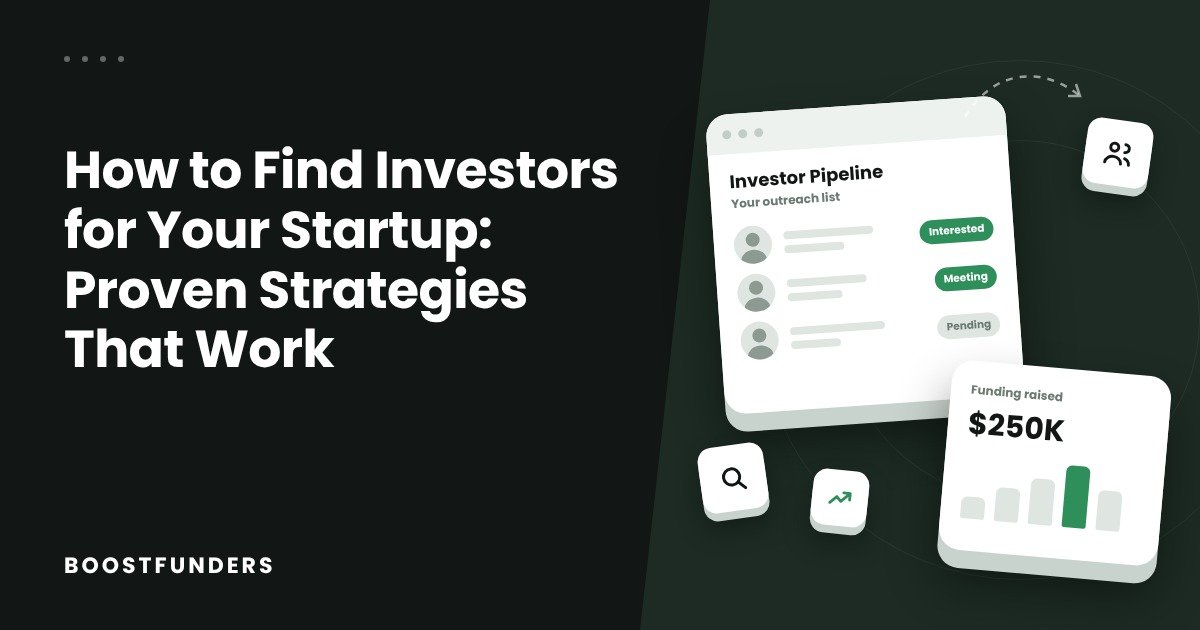
A spreadsheet or simple CRM is enough. What matters is that every status means something specific. Track name, firm, role, fit rationale, source, preferred contact route, owner, last interaction, next action and date, and record any amount as an indication, not confirmed money.
| Where it stalls | What to examine |
|---|---|
| Suitable investors rarely reply | Targeting, delivery and your opening explanation |
| Meetings don't progress | Evidence, investment case and repeated objections |
| Diligence drags | Missing documents, weak assumptions or unclear decision timing |
Some investors pass for reasons unrelated to you, such as portfolio overlap or available capital. Also track the founder time fundraising costs: repeated low-fit calls pull attention from customers.
13. Run Meetings and Follow-Ups With a Clear Next Step
Research the investor before each meeting and prepare for the issues most relevant to them. Answer the question that was asked: if they ask about churn, give the actual measure, period and context, not signups. If you don't know, say what's missing and when you'll follow up. Explain your biggest risks plainly, and ask about their process: who decides, what they need, what would stop a deal, and what timeline is realistic.
If there's no reply, one follow-up after a reasonable gap is fine, as long as it adds new information or a clear question. After a clear no, stop unless they invite a future update. Never invent another investor's commitment, a fake deadline or an "oversubscribed" round to create urgency; real progress is stronger.
14. Evaluate the Investor Before Accepting
An investor can stay connected to your company for years. Speak to founders they've backed, including one whose company struggled, about responsiveness, behavior in hard times, follow-on decisions and how disagreements were handled. Then review the actual terms: valuation is only one part, alongside ownership, dilution, liquidation preferences, voting, board seats, information rights and future participation rights. The NVCA model legal documents show the kinds of agreements used in venture financings, but they're references, not a substitute for reviewing your own documents.
Red flags to investigate
Unexplained "release fees", pressure for secrecy, urgent payments to unrelated accounts, or changed payment instructions you haven't verified through a known channel. Some legitimate programs do charge disclosed fees, so ask exactly what you're paying for and what happens if no investment follows.
Be careful with paid finders. The SEC's broker-dealer guide for small businesses says finding investors for a funding round, and being paid based on the outcome or size of the deal, can mean someone needs to be registered as a broker-dealer. Have any finder or success-fee arrangement reviewed before you agree to it. Calling it "consulting" doesn't change its legal status.
15. A Practical 30-Day Plan
This is an example of a first work cycle, not a promise to close a round in a month. Adapt it to your readiness, legal route and operating demands.
Establish the funding case
Confirm the milestone, cash plan, capital type and offering route. Review the deck and assumptions, close ownership or document gaps, and write your investor profile.
Research and prioritize
Build a list from official criteria, credible directories and relationships. Verify the key facts and pick a first batch you can actually handle.
Start the right conversations
Request specific intros and send approved direct outreach. Log the questions you're asked. If feedback exposes a real gap, fix it before sending more.
Follow up and improve
Answer open requests, update the pipeline, and review which sources produced good conversations. Plan the next cycle around evidence.
16. When Professional Fundraising Support Helps
Outside help is useful when you have a credible business case but need support with research, positioning, materials, outreach coordination or campaign communication. Be specific about deliverables: investor criteria, source verification, tailored messaging, meeting prep, pipeline management and reporting, and know which work stays with you.
Boostfunders' Investor Outreach & Lead Generation supports targeting, research, outreach and pipeline coordination, and its Startup Fundraising Advisory covers the preparation behind the raise. Raising through a community round instead? Read what to know before hiring an equity crowdfunding marketing agency.
17. FAQs
18. Conclusion
Finding investors gets more practical when every activity has a purpose. Research finds suitable people, preparation makes your company easy to assess, outreach starts relevant conversations, and follow-up resolves uncertainty. Begin with the funding case, verify fit, choose your legal route, and start with a manageable first set of conversations.
Keep your claims accurate, your records current and your business moving while you raise. The right result is capital on terms that help you progress, from investors whose expectations you understand and can work with for years.