For years, startup fundraising was described as a fairly simple ladder: build something promising, meet angels, raise a seed round, then convince venture funds to keep financing the company as it grows. That path still exists, but it is no longer the only serious way for an early-stage company to raise equity.
A founder with a loyal customer base, a strong online community, a recognizable local brand, or thousands of users can now ask a different question: instead of giving the entire round to a small group of professional investors, should some or all of the ownership opportunity be opened to the people who already use, recommend, and care about the company?
That is the strategic idea behind a community round. Venture capital, by contrast, concentrates the raise around a smaller number of professional investors who can write larger checks and may bring industry knowledge, board participation, recruiting help, follow-on capital, and institutional signaling. Neither model is automatically more founder-friendly. They create different advantages — and different obligations.
Key Takeaways
- Choose a community round when your strongest fundraising advantage is trust and reach — people already know the product or want to participate in the upside
- Choose VC when your strongest need is concentrated capital plus institutional support — a lead investor, specialist knowledge, recruiting leverage, or follow-on capacity
- The answer can be "both" — some startups anchor with VC and open a portion of the round to customers, or use a community round to prove demand before approaching institutional funds
- A community round is a strategy, not a legal exemption — it often uses Regulation Crowdfunding, but the security can still be a SAFE, equity, preferred stock, or debt
- Capital need is one of the fastest filters — Reg CF currently caps eligible issuers at $5 million in a rolling 12-month period, so capital-intensive businesses often need traditional VC
- Governance depends on the instrument and documents in both models — "community round means founder control" is a myth without checking the actual securities and rights involved
1. The Short Answer: Community Round or VC?
Choose a community round when the company's strongest fundraising advantage is trust and reach: people already know the product, care about the mission, or want to participate in the company's upside. Choose VC when the company's strongest need is concentrated capital plus institutional support: a few large checks, a lead investor, specialist knowledge, recruiting leverage, board-level guidance, or a financing partner with the capacity to support later rounds.
The answer can also be "both." A community round and a VC round are not mutually exclusive identities. Some startups use venture investors to anchor the financing and then open a portion of the round to customers or supporters. Others use a community round to prove investor demand, deepen customer alignment, or finance an early milestone before approaching institutional funds.
2. What a Community Round Actually Is
A community round is a financing strategy in which a startup intentionally allows a broader group of people close to the business — customers, users, fans, local supporters, creators, employees, members, or other followers — to invest. The term describes who participates and how the round is positioned. It does not, by itself, determine the legal exemption or the security being sold.
Wefunder makes the distinction clearly: a community round is a strategy, not a legal exemption. On its platform, community rounds often use Regulation Crowdfunding, which can allow both accredited and non-accredited investors to participate. The security can still be a SAFE, equity, preferred stock, debt, or another permitted instrument depending on the offering.
- Who may participate — customers, users, fans, supporters, community members, accredited investors, and, under Reg CF, eligible non-accredited investors
- How the raise feels — more public, campaign-driven, content-heavy, and dependent on community activation than a typical private VC process
- What it is not — a donation campaign, preorder, or Kickstarter-style reward campaign. Investors are purchasing securities and can lose their investment
3. What Traditional VC Funding Actually Is
Venture capital is institutional equity financing for companies that investors believe can grow rapidly and produce outsized returns. A VC fund typically invests capital raised from its own limited partners into a portfolio of startups, expecting that a small number of major outcomes may drive the fund's returns.
The process is usually relationship-driven and private. Founders meet partners, send decks and data rooms, answer diligence questions, negotiate valuation and terms, and — in a priced equity round — often issue preferred stock. The legal package can include a stock purchase agreement, investors' rights agreement, voting agreement, right of first refusal and co-sale agreement, and amendments to the company's charter. The National Venture Capital Association publishes model versions of these documents because they are common building blocks of institutional venture financings.
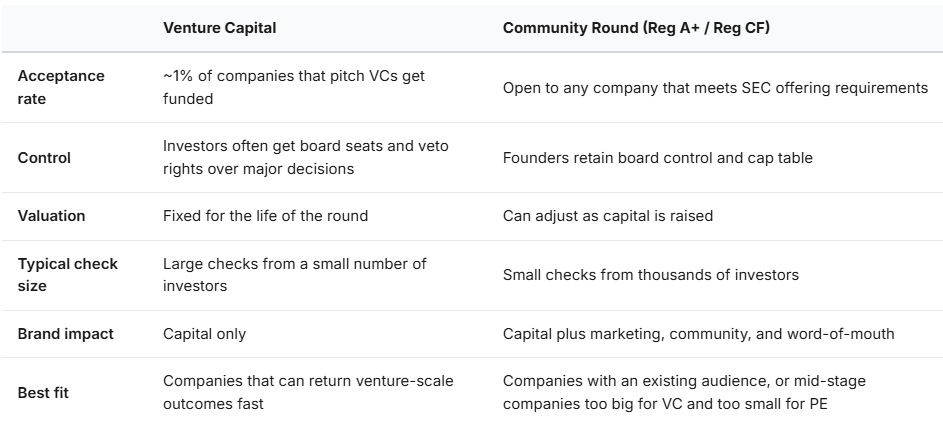
4. Community Round vs VC Funding: Side-by-Side
| Dimension | Community Round | VC Funding |
|---|---|---|
| Investor base | Hundreds or thousands of smaller checks | A handful of firms or partners with larger checks |
| Legal route | Often Reg CF; SAFE, equity, or debt possible | Priced equity, SAFEs, or convertible notes |
| Process | Public, campaign-driven, content-heavy | Private, relationship-driven, diligence-heavy |
| Governance | Depends on instrument; often lighter with SAFEs | Can include board seats, voting, protective provisions |
| Capital ceiling | $5 million per 12-month period under Reg CF | No statutory ceiling; scales with investor appetite |
| Signaling | Broad participation signals affinity and trust | Firm brand and partner reputation signal credibility |
| Follow-on capacity | Fragmented; some investors may reinvest | Funds often reserve capital for follow-on rounds |
| Best fit | Reachable audience, understandable product, public comfort | Capital-intensive business, need for a lead investor |
5. The 2026 Funding Environment Matters
The choice is also shaped by the market you are raising into. Venture funding improved materially in early 2026, but access is not evenly distributed. Carta reported $30.4 billion in startup funding in Q1 2026 and noted that more than 60% of capital raised by companies on its platform went to AI companies. That does not mean non-AI companies cannot raise venture capital. It does mean founders should be realistic about how sector concentration affects competition for institutional attention.
A community round can widen the fundraising surface area for a company that already has public trust but does not fit the hottest venture categories. It is not a shortcut around weak fundamentals. Customers will not automatically become investors, and a public campaign can expose weak traction just as quickly as a VC meeting can.
6. Investor Access: Many Smaller Checks vs a Few Large Checks
The most visible difference is concentration. A VC round may depend on convincing a handful of firms or partners. A community round may depend on convincing hundreds or thousands of individuals. That changes the mathematics of the raise.
The smaller-check model creates resilience because the round is not dependent on a single decision-maker. It also creates a distribution problem: you need enough qualified people, enough trust, and enough conversion. A $1 million community round is not "easier" than a $1 million VC round; it is a different sales motion.
7. Capital Size and Capital Intensity
Capital need is one of the fastest filters. If the company requires tens of millions of dollars before it can reach the next meaningful technical, regulatory, manufacturing, or market milestone, a pure Reg CF community round may be insufficient because the federal exemption currently caps eligible issuers at $5 million in a rolling 12-month period.
That makes traditional VC, growth equity, strategic investors, project financing, debt, Regulation A, or a hybrid structure more relevant for capital-intensive businesses. Community rounds are often strongest when the required amount fits within the exemption and the company already has an audience capable of supporting the raise.
8. Ownership and Dilution
Both community capital and VC can dilute founders. The question is not whether dilution exists; it is what you receive in exchange for it and what rights attach to the securities.
Carta's 2026 founder ownership research found that the median founding team retained about 56% of fully diluted equity by the time a company had raised a seed round, based on its dataset of rounds from 2021 through 2025. That is a useful reminder that dilution compounds quickly, but it is not a target every startup should copy. Ownership outcomes vary widely by co-founder count, employee option pools, SAFE/convertible-note history, valuation, round size, and financing terms.
9. Governance, Control, and Investor Rights
This is where simplistic "community round = founder control" claims fall apart. Governance depends on the instrument and documents. A community round using a SAFE may create relatively limited immediate governance rights. A priced preferred-stock round sold to the community can carry more formal rights. A VC financing can range from founder-friendly to highly protective depending on the negotiation.
Institutional VC rounds often negotiate information rights, voting arrangements, protective provisions, rights of first refusal, pro rata participation, and sometimes board representation. Those mechanisms are not inherently bad; they reflect the fact that a concentrated investor may own a meaningful stake and is expected to participate in governance.
10. Cap Table Complexity and SPVs
Founders often worry that a community round will put hundreds of names directly on the cap table. That can happen depending on structure, but some platforms use special-purpose vehicles or crowdfunding vehicles to aggregate investors. Wefunder states that both its private and community rounds can consolidate investors into a single line on the cap table through an SPV structure.
Do not assume aggregation solves every administrative issue. The company can still have many beneficial investors who expect updates, ask questions, and may have rights flowing through the vehicle. Cap-table simplicity and investor-relations simplicity are not the same thing.
11. Public Marketing vs Private Fundraising
Community rounds are built around visibility. Reg CF permits public-facing marketing, but the content and treatment of offering terms are regulated. Traditional VC fundraising is usually far quieter: targeted emails, introductions, meetings, partner calls, and private diligence.
That difference should influence your choice. A consumer company with a passionate customer base may gain brand value from announcing that customers can become owners. A stealth deep-tech company working around confidential intellectual property may not want a public financing process at all.
For a practical funnel approach, see PledgeWire's How to Build an Investor Funnel for an Equity Crowdfunding Campaign.
12. Speed, Preparation, and Founder Workload
Both paths are time-consuming, but they consume founder attention differently. VC fundraising concentrates the workload in investor targeting, introductions, pitch meetings, diligence, negotiation, and legal closing. Community fundraising distributes the workload across campaign preparation, audience building, content, email, investor Q&A, public updates, compliance coordination, paid promotion, and many smaller conversion events.
Wefunder's launch guidance makes the point plainly: launch day reveals demand; it rarely creates it. A community round should be prepared before it goes live, with demand lined up, terms and disclosures settled, and a campaign plan the team can sustain.
13. Due Diligence and Disclosure
VC diligence is usually private and customized. A fund may request financial statements, cap-table records, customer contracts, product metrics, legal documents, intellectual-property assignments, security practices, reference calls, and detailed operating data. The depth depends on stage, check size, investor, and sector.
Reg CF creates a different disclosure regime. Eligible issuers must file Form C and provide specified information to investors and the intermediary. Financial statement requirements scale with offering size and history, and ongoing reporting can continue after the raise until a termination condition is met. Public disclosure can be a feature when transparency builds trust — and a cost when founders would prefer confidentiality.
PledgeWire's Reg CF Explained: What Founders Must Know Before Raising Equity explains the filing, financial statement, advertising, and reporting framework in more detail.
14. Signaling, Credibility, and Strategic Value
A strong VC can provide a concentrated signal to future investors, recruits, partners, and customers. The firm's brand, partner reputation, portfolio, and follow-on participation can influence how the market interprets the company. That signaling effect is one reason founders sometimes accept dilution beyond the cash itself.
Community rounds create a different signal: broad participation. Hundreds or thousands of customers investing can demonstrate affinity, trust, or product evangelism. But founder teams should not confuse participation with commercial traction. Investors are not necessarily customers, and campaign success does not automatically prove sustainable unit economics.
15. Follow-On Funding and Future Rounds
Follow-on capacity matters if the company will almost certainly need multiple rounds. A venture firm may reserve capital to invest again, help recruit additional firms into later rounds, and provide continuity in the financing process. A community investor base is more fragmented; some individuals may increase their investment later, but the company cannot assume the crowd will finance every stage.
This does not make community capital a dead end. Wefunder notes that it supports companies from early stages through later rounds, and that community and institutional capital can coexist. The important question is whether today's structure keeps tomorrow's financing options open.
16. Community as Distribution
The most interesting advantage of a community round is that capital can double as distribution. Investors who are already customers or users may become stronger advocates, referrers, testers, event participants, or brand ambassadors because ownership deepens the relationship. Wefunder describes this as "capital plus distribution." That is a useful strategic idea, but it should be treated as an upside rather than a guarantee. The company still needs a product people want and a system for communicating with the investor community after closing.
17. When a Community Round Is the Better Fit
- You already have a reachable audience — customers, users, subscribers, members, local supporters, creators, or a founder following can be contacted directly
- The product is understandable — people can quickly grasp what the company does, why it matters, and why they might want to own a piece of it
- The raise amount fits the structure — your financing need is compatible with the legal route and realistic investor demand
- Ownership itself strengthens the brand — customer-investors could deepen loyalty, referrals, or community identity
- You are comfortable operating publicly — the team can support disclosures, campaign updates, founder visibility, and ongoing investor communications
- You want broader participation — making ownership accessible beyond accredited investors is part of the strategy, not a marketing afterthought
For the marketing side of this model, see PledgeWire's How to Promote a Wefunder Campaign and Get More Investors.
18. When VC Is the Better Fit
- You need a small number of large checks — the financing need is too large or too concentrated to build efficiently from hundreds of smaller investments
- The company is capital-intensive — biotech, advanced hardware, infrastructure, semiconductors, and deep tech may require repeated institutional financing before revenue can support the business
- You need a lead investor — a sophisticated investor can help set terms, organize the syndicate, and support diligence
- Specialist expertise is valuable — the right fund can bring hiring networks, customers, regulatory knowledge, or follow-on financing relationships
- You want a private process — the company prefers targeted diligence and confidential negotiation rather than a public campaign
- Future institutional rounds are central to the strategy — the company expects a financing ladder where investor signaling and reserves matter materially
If the problem is finding the right institutional targets rather than deciding the funding route, Boostfunders' investor outreach and lead generation service outlines a targeted investor-research and outreach process.
19. When Neither Path Is Right Yet
A founder can be too early for both a public community round and institutional VC. If the company has no validated customer problem, no credible product, no evidence of demand, unresolved founder or cap-table issues, weak financial records, or no clear use of proceeds, fundraising can simply expose those weaknesses to a larger audience.
In that situation, bootstrapping, grants, accelerator support, customer-funded development, a small friends-and-family round, or more validation work may be more sensible. Capital should finance progress, not postpone the moment when the startup has to prove it deserves to exist. Our companion guide, Bootstrapping vs Raising Capital: When to Fund Yourself vs Seek Investors, covers that earlier decision in detail.
20. The Hybrid Strategy: VC Plus a Community Slice
The strongest answer for some startups is not community versus VC but community alongside VC. A lead investor can provide pricing, diligence, signaling, and a large anchor check. The community can then participate on aligned or coordinated terms, turning customers and supporters into owners without asking them to carry the entire financing burden.
This structure can be attractive for brands with genuine communities that also need institutional support. It requires careful sequencing. The company must coordinate securities exemptions, terms, closing mechanics, public communications, cap-table treatment, and what happens if one part of the financing changes.
For U.S. founders, many community rounds use Regulation Crowdfunding. The current SEC framework permits eligible companies to raise up to $5 million through Reg CF during a rolling 12-month period. Transactions must occur through one SEC-registered broker-dealer or funding portal, and the issuer must provide required disclosures.
22. Typical VC Legal Mechanics Founders Should Expect
Traditional venture rounds are negotiated transactions. The headline valuation is only one term. Founders should understand the complete legal and economic package before deciding a VC offer is "better" than a community round.
- Preferred stock and liquidation preference — institutional investors commonly purchase preferred shares with rights that differ from common stock
- Board and voting rights — investors may negotiate board representation, observer rights, voting agreements, or approval rights over major company actions
- Pro rata or participation rights — investors may have rights to maintain ownership in future financings
- Information rights — regular financial and operating reporting can become a contractual obligation
- ROFR and co-sale provisions — founder share transfers may be subject to rights of first refusal or co-sale mechanics
- Option pool effects — a financing may require expanding the employee option pool, which can affect founder dilution depending on how the pre-money/post-money economics are structured
24. Four Realistic Founder Scenarios
Scenario A — the consumer brand with 40,000 customers: The company has repeat buyers, an active email list, strong social engagement, and needs $1.5 million for inventory, retail expansion, and team growth. A community round is strategically compelling because the fundraising audience already exists and ownership can deepen brand advocacy. A VC or strategic investor could still anchor the financing if the founders want retail expertise and follow-on capacity.
Scenario B — the preclinical biotech company: The startup has compelling science but needs $8 million to reach a meaningful development milestone. Its real financing need is specialist diligence, large checks, regulatory knowledge, and follow-on capital. VC or specialist life-sciences investors are likely the more natural first route, potentially with other financing tools alongside them.
Scenario C — the profitable local food company: The business has a recognizable regional brand, thousands of loyal customers, and wants $750,000 to open a second production facility. It may not fit a traditional venture return model, but a community round can align local supporters with expansion if the economics, risks, and offering structure are credible.
Scenario D — the AI infrastructure startup: The team has early enterprise pilots but requires fast hiring and significant compute. In a 2026 market where AI has attracted a disproportionate share of venture capital, a targeted VC process may provide larger checks, recruiting support, and signaling. A later community slice could still make sense if the company develops a meaningful user or developer ecosystem.
25. A 12-Question Decision Framework
- Do we have a reachable community that already trusts the company?
- Would those people understand why owning part of the company is meaningful?
- How much capital do we need to reach the next genuinely valuable milestone?
- Does that amount fit the legal and practical limits of a community round?
- Do we need one or more institutional investors to lead the round and set terms?
- How valuable would sector expertise, recruiting help, board participation, or follow-on capital be?
- Are we comfortable with public disclosure and public investor questions?
- Do we have the marketing capacity to run a campaign for weeks or months?
- Would broader ownership strengthen our customer or user strategy?
- How much dilution are we willing to accept, and what rights come with it?
- Will today's structure make the next financing easier or harder?
- If neither path were available, what proof could we create through bootstrapping before fundraising?
26. Common Mistakes
- Choosing community fundraising because VC said no — a community round still requires a credible business, terms, disclosures, investor demand, and a reachable audience
- Choosing VC because the announcement looks prestigious — institutional money is useful when it buys capability or speed, not merely status
- Comparing only valuation — governance, liquidation economics, option pools, future rights, and investor obligations matter
- Assuming customers will invest automatically — loving a product and underwriting a private-company investment are different decisions
- Assuming hundreds of investors create no operational work — vehicles can simplify the cap table, but investor relations still require discipline
- Ignoring the next round — a financing structure should be evaluated for how it affects the company's next stage, not only today's cash
- Launching before building demand — community rounds are usually won before launch through audience preparation and early commitments
- Running a broad VC blast — institutional fundraising works better when investor targets fit stage, sector, geography, check size, and thesis
27. Fundraising Readiness Checklist
- 1.Clear target amount, minimum amount, use of proceeds, and 12-18 month milestones
- 2.Clean incorporation, founder equity, IP assignments, cap table, and historical securities records
- 3.Up-to-date financial statements, budget, runway model, and operating assumptions
- 4.Credible traction metrics with definitions and dates, plus investor materials covering problem, solution, market, and risks
- 5.Community data — customer list, email subscribers, active users, social audience, and engagement quality
- 6.VC data — target investor profile, relevant firms, partner-level contacts, stage fit, and portfolio conflicts
- 7.Legal counsel familiar with the intended securities exemption, plus a data room for diligence or Reg CF disclosure
Founders who need help deciding the route or preparing the raise can also review Boostfunders' Startup Fundraising Advisory.
📘 Read This FirstReg CF Explained: What Founders Must Know Before Raising Equity
Understand the disclosure and compliance framework behind Regulation Crowdfunding before you decide between a community round, VC, or a hybrid structure.
Read the full guide →29. Final Verdict: Match the Capital to the Company
Community rounds and venture capital are not competing versions of the same financing product. They are different systems for converting belief in a startup into capital. One distributes conviction across a broad group of supporters. The other concentrates conviction in professional investors who can bring larger checks and institutional resources.
If your company already has a genuine audience, the raise fits the legal and practical range, and community ownership strengthens the business, a community round can turn customers into stakeholders and capital into distribution. If your company needs large, concentrated financing, specialist expertise, a lead investor, private diligence, and substantial follow-on support, VC may be the stronger path.
If you need both, build the financing deliberately. Institutional investors and community investors can coexist when the terms, exemptions, governance, cap-table structure, and communications are designed to work together.
Frequently Asked Questions