There is a moment in almost every startup when the founder looks at the next twelve months and asks the same question: do we keep financing this ourselves, or is it time to bring in outside capital? The question sounds financial, but it is really strategic. Your answer affects ownership, hiring, growth speed, product decisions, governance, personal risk, and even the kind of company you are building.
Bootstrapping has an attractive story around it. You keep control, stay close to customers, and avoid dilution. Raising capital has an equally attractive story: hire faster, build faster, enter the market sooner, and stop making every decision around the balance in the bank account. Both stories are true in the right company. Both can also become expensive mistakes when founders apply them as ideology instead of tools.
Capital should solve a constraint that money can actually solve. If the company still does not know who the customer is, why they buy, or whether the product creates enough value, outside money can simply fund a larger version of the uncertainty.
Key Takeaways
- Bootstrapping preserves ownership and flexibility, but the founder carries more financial risk and may accept slower hiring, product development, or market expansion
- Raising capital can buy speed, capacity, credibility, inventory, infrastructure, or distribution — but it also creates dilution, investor expectations, and fundraising overhead
- The best decision starts with the next 12-18 month milestone. Ask whether cash is truly the binding constraint or whether the company still needs more learning
- Capital-intensive businesses such as hardware, biotech, manufacturing, and some marketplaces may be structurally harder to bootstrap than software or service businesses
- Outside capital is broader than VC — friends and family, angels, accelerators, community rounds, Reg CF, debt, grants, and customer financing are all part of the menu
- The worst reason to raise is "we need more runway." The better question is "what specific milestone will this money buy, and what becomes true if we reach it?"
1. The Short Answer: Bootstrap or Raise?
Bootstrap when the company mainly needs focus, customer feedback, iteration, and proof. Raise when the company has a credible direction and outside capital materially improves the odds of reaching a valuable milestone before the opportunity closes.
That is deliberately different from saying "bootstrap until profitable" or "raise as soon as investors are interested." A startup can be pre-revenue and still rationally raise if it needs expensive technical development, regulated testing, inventory, or infrastructure before revenue is possible. Another startup can have healthy revenue and still choose not to raise because it can fund growth internally without giving up ownership or changing the operating model.
If you received $1 million tomorrow, could you explain — line by line — what you would spend it on, which milestone that spending should produce, and how you would know within 12-18 months whether the plan worked? If not, the company may need clarity before capital.
2. What Bootstrapping Really Means
Bootstrapping means financing the business primarily from the founders' own resources and the cash the company generates, rather than selling ownership to outside investors. In practice, bootstrap funding can include personal savings, founder income, early customer payments, consulting revenue, retained earnings, preorders, and sometimes support from friends or family.
The U.S. Small Business Administration describes self-funding as a path that lets owners retain control while also taking on the financial risk themselves. That tradeoff is the heart of bootstrapping. The founder keeps more of the upside, but there is no investor balance sheet absorbing the downside.
- Common bootstrap sources — personal savings, founder salary, early sales, service revenue, preorders, retained earnings, and carefully structured family support
- What bootstrapping is not — it does not mean spending nothing. It means the company finances spending without relying on a major outside equity raise
- What changes operationally — cash constraints become part of product strategy, hiring strategy, marketing strategy, and the pace at which the company can experiment
The obvious appeal is ownership, but the deeper appeal is freedom. A bootstrapped founder can change direction without first managing a board narrative, choose a slower but profitable niche, or keep building a business that is valuable even if it never becomes a billion-dollar company. For many founders, that flexibility is worth more than the prestige of announcing a funding round.
3. What Raising Capital Really Changes
Raising capital means bringing in money from outside parties under terms that create an obligation. In equity financing, that obligation is primarily ownership and investor rights rather than scheduled repayment. In debt, the company promises repayment and usually interest. Convertible instruments such as SAFEs or notes sit between early cash and later equity outcomes.
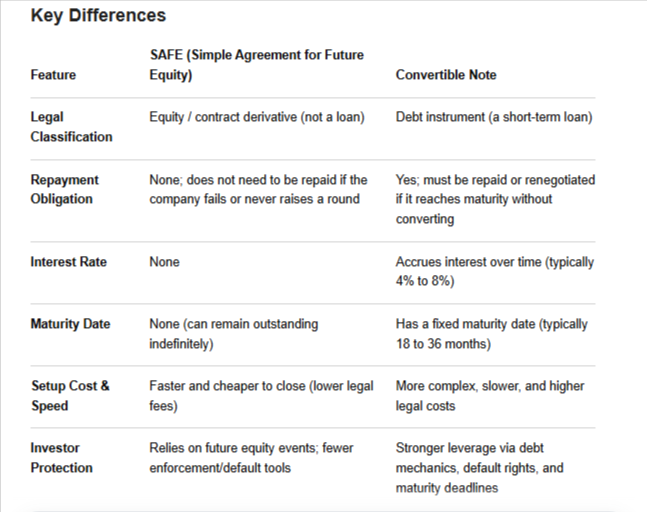
The SBA notes that venture capital is generally exchanged for an ownership share and often a more active role in the company. Carta's equity-financing guidance likewise emphasizes that founders need to understand valuation, dilution, and the differences among priced equity, convertibles, and the stages at which they are commonly used.
After a raise, the founder is no longer optimizing only for customers and the company. Investor communication, governance, future fundraising, cap-table planning, and financing milestones become part of the operating system.
4. Bootstrapping vs Raising Capital: Side-by-Side
| Dimension | Bootstrapping | Raising Outside Capital |
|---|---|---|
| Ownership | Founders retain more ownership if they do not issue equity | Equity and equity-linked rounds dilute current holders over time |
| Control | Usually high founder flexibility | Depends on voting, board, consent, and investor rights |
| Speed | Growth pace limited by cash generation and founder resources | Can accelerate hiring, product development, inventory, sales, and expansion |
| Financial risk | More risk may sit with the founder personally | Investors share business risk, but founders give up economics and accept obligations |
| Customer discipline | Revenue and willingness to pay become immediate signals | More runway can allow longer experimentation, but can also hide weak demand |
| Fundraising time | Little or no institutional fundraising process | Can consume months of founder attention, diligence, and negotiation |
| Best fit | Lower-capital businesses, early learning, profitable niches | Capital-intensive businesses, validated growth engines, timing-sensitive markets |
5. Start With the Bottleneck, Not the Funding Method
Founders often approach funding backward. They decide they want to raise, then search for a story that justifies the amount. A more useful process starts with the bottleneck. What specifically prevents the company from reaching the next important milestone?
- Customer understanding — more interviews, product iteration, or positioning work may matter more than capital
- Product proof — a smaller bootstrap phase, prototype, pilot, or preorder test may create the evidence needed before a larger raise
- Capacity — capital may let you hire engineers, salespeople, or operators against a model that already works
- Inventory or infrastructure — outside capital, debt, purchase-order financing, or customer deposits may be structurally necessary
- Market timing — moving slowly may itself be expensive if competitors, network effects, regulation, or distribution windows reward speed
Wefunder's guidance frames the same core idea in milestone terms: fundraising makes more sense when cash is what blocks execution, rather than when the company still needs basic product or market clarity.
6. Capital Intensity: Can This Business Realistically Self-Fund?
Some businesses are naturally easier to bootstrap because the founder can create and sell the first version with limited fixed cost. Consulting, agencies, software tools, education products, and some marketplaces can often reach customers before requiring a large team or expensive physical infrastructure.
Other businesses have a financing problem before they have a revenue problem. Hardware may require tooling, certifications, deposits, and manufacturing inventory. Biotech may require research, trials, laboratories, and regulatory work. Deep-tech companies can spend years building before meaningful revenue. In these cases, "just bootstrap" can be less a strategy than a refusal to acknowledge the economics of the model.
| Business Characteristic | Bootstrapping Tendency | Capital-Raising Tendency |
|---|---|---|
| Low marginal cost, founder can build and sell | Strong | Optional |
| Large inventory commitment before sales | Harder | Often useful |
| Long R&D cycle before commercial revenue | Harder | Often necessary |
| High regulatory/certification cost | Harder | Often useful |
| Service revenue can finance product development | Strong | May be delayed |
| Profitable niche with moderate growth ambition | Strong | Often unnecessary |
7. Speed, Timing, and the Cost of Moving Slowly
Founders usually describe fundraising as a cost because it creates dilution. But bootstrapping also has a cost: time. The company may hire later, launch later, order smaller inventory quantities, enter fewer markets, or fail to invest in distribution while a competitor establishes the category.
The key is to distinguish useful speed from expensive motion. Spending three times more does not automatically produce three times more progress. Capital only creates an advantage when the team knows how additional resources translate into faster learning, stronger product, lower unit costs, or durable market position.
If you doubled the company's monthly spend, which metric or strategic capability should improve? If the answer is vague — "more awareness," "more growth," or "bigger team" — the company may not yet know how to deploy capital efficiently.
8. Ownership, Dilution, and the Price of Capital
Equity capital does not create a monthly repayment obligation, but that does not make it free. The price is a share of future enterprise value and, depending on the financing, a package of investor rights. The more rounds a startup raises, the more the ownership picture can change.
Dilution is not automatically bad. Owning a smaller percentage of a much more valuable company can be better than owning all of a company that never reaches the market. The important question is whether the capital materially increases the expected value of the company relative to the ownership given up.
| Illustrative Outcome | Founder Ownership | Company Value | Founder's Paper Value |
|---|---|---|---|
| Bootstrap outcome | 100% | $2 million | $2 million |
| Funded growth outcome | 60% | $20 million | $12 million |
| Overfunded but weak execution | 55% | $3 million | $1.65 million |
These figures are illustrative only. The table is not a forecast; it shows why dilution cannot be evaluated without considering what the capital changes.
Founders sometimes treat SAFEs as if they postpone dilution rather than create it. In reality, the conversion mechanics determine how future equity is allocated. Stripe's guide to SAFE conversion explains how valuation caps and pre-money versus post-money structures can affect ownership when a SAFE converts. Founders should model conversion before signing, not after the next round arrives.
9. Control, Governance, and Investor Expectations
"Will I lose control?" is too blunt a question. Control depends on documents. A founder can own a majority of shares and still accept governance restrictions. Another founder can be diluted below a majority while keeping meaningful board influence. Voting thresholds, board composition, protective provisions, information rights, and future financing terms matter as much as the headline ownership percentage.
The SBA notes that venture investors commonly seek an active role, which may include a board seat or other governance rights in institutional rounds. Community rounds may spread ownership across many individuals while using structures designed to simplify cap-table administration, but the legal and governance effect still depends on the actual security and documents.
For a deeper look at public-facing startup securities and private rounds, see PledgeWire's Public vs Private Investing: What Startup Investors Need to Know in 2026.
10. Runway, Burn Rate, and Personal Financial Risk
Bootstrapping often feels safer because there are no outside investors, but the founder can be taking more personal risk. Savings may be depleted, salaries deferred, personal guarantees signed, or retirement security compromised. The SBA specifically warns owners to be cautious about spending more than they can afford and about the consequences of using retirement funds.
Outside investment shifts part of the financial risk to investors, but it creates another kind of pressure: a finite runway with a larger cost base. A company that raises $2 million and immediately builds a 15-person team may become less flexible than a bootstrapped company spending one-tenth as much. Runway is not safety if the burn rate becomes structurally difficult to reduce.
Treat runway as the number of months available to reach the next financing-independent milestone — not simply the number of months before the bank account reaches zero.
11. Customer Discipline: One Hidden Advantage of Bootstrapping
Bootstrapped companies often receive harsher but cleaner market feedback. If customers do not pay, the company feels it quickly. That can force founders to narrow the customer, simplify the product, improve pricing, and focus on channels that actually produce revenue.
Funded companies can afford longer experiments, which can be valuable in research-heavy markets. But excess runway can also weaken signal. A startup may confuse advertising spend with product-market fit, headcount with progress, or free usage with willingness to pay. Capital does not create demand simply because it creates activity.
12. Why Traction Can Improve Your Fundraising Position
Waiting to raise can be strategically valuable when the waiting period creates proof. Revenue, customer retention, signed pilots, purchase orders, growth efficiency, product usage, regulatory milestones, or repeat demand can reduce the amount of uncertainty investors are being asked to price.
That does not guarantee a higher valuation or easier round. Markets change, investor appetite changes, and every company is different. But a founder negotiating with real traction usually has more options than a founder whose entire case rests on a forecast. Options matter because they reduce the pressure to accept the first available terms.
PledgeWire's How to Build an Investor Funnel for an Equity Crowdfunding Campaign explains how investor acquisition becomes easier to structure once the company has a clear evidence-based story to nurture prospects around.
13. When Founders Raise Too Early
Early capital can create the appearance of momentum before the company has earned strategic clarity. That is especially dangerous when fundraising itself becomes the validation metric. An investor saying yes proves that the investor believes the opportunity is worth the risk; it does not prove customers will buy or retain the product.
- You are raising because the company is running out of cash, but you cannot explain what the next round will achieve
- You have not identified a repeatable customer or use case and plan to use a large team to "figure it out"
- The product can be tested cheaply, but the company wants to raise before doing the cheap test
- Your forecast assumes growth without showing the channel or unit economics that should produce it
- You spend more time optimizing the pitch than speaking with customers
14. When Founders Bootstrap for Too Long
Bootstrapping becomes a problem when capital efficiency turns into strategic underinvestment. Founders can become so proud of surviving cheaply that they refuse to spend even when the company has evidence that more investment would produce a meaningful return.
- Customers are waiting, but the company cannot build or deliver fast enough
- A competitor is capturing distribution or network effects while you deliberately remain small
- Unit economics are proven, but growth is constrained by inventory, sales capacity, or geographic expansion
- Critical hires are delayed even though the business can explain how those hires increase throughput
- Founder burnout is becoming a business risk because one person is doing the work of an entire team
- You have a narrow regulatory, market, or technology window and slow execution could close it
The point is not that every growing company should raise. It is that founder ownership has value only if the company can still capture the opportunity. One hundred percent of a missed market is not a victory.
15. Your External Capital Menu: Not All Money Is VC
The bootstrap-versus-VC debate is too narrow. Founders have a broader financing menu, and different sources solve different problems. The SBA itself presents self-funding, investors, loans, and crowdfunding as distinct paths rather than a single ladder every company must climb.
| Capital Source | What You Usually Give | Best Used When |
|---|---|---|
| Friends & family | Equity, SAFE, note, or informal risk | Very early proof and trusted network support |
| Angel investors | Equity or convertibles | Pre-seed/seed, expertise and network matter |
| Venture capital | Equity + negotiated rights | Large market, speed, high-growth model |
| Accelerators | Often equity for capital/program access | Founders need structure, network, mentorship |
| Community round / Reg CF | Securities sold through a registered intermediary | Company has customers, fans, or broad investor story |
| Debt / loans | Repayment + interest; sometimes collateral | Predictable cash flow or asset-backed needs |
| Grants | Usually no equity; eligibility and reporting | Research, impact, innovation, government-aligned programs |
| Customer financing / preorders | Future delivery, discounts, service obligations | Product demand can finance production or development |
Founders comparing programs can also review Boostfunders' accelerator and incubator strategy service for a framework on whether an accelerator or incubator actually fits the company's stage and needs.
16. Community Rounds and Equity Crowdfunding as a Middle Path
A community round does not mean the startup is bootstrapping. It is still raising outside capital. What changes is who can participate and how the round is distributed. Instead of depending entirely on a small number of VCs or angels, a founder may invite customers, users, supporters, and other individuals to invest through a compliant structure.
Wefunder describes community rounds as a way for startups with real audience trust to combine capital formation with broader customer or community ownership. That can be especially attractive for consumer companies, local businesses, mission-led startups, and products with a strong base of advocates.
In the U.S., many public-facing community rounds use Regulation Crowdfunding. The SEC's current issuer guidance permits eligible issuers to raise up to $5 million in a 12-month period through a registered broker-dealer or funding portal, subject to disclosures, investor limits for many non-accredited investors, and other requirements.
For the offering rules, see PledgeWire's Reg CF Explained: What Founders Must Know Before Raising Equity. For platform mechanics, Boostfunders also has a complete founder's guide to how Wefunder works.
17. Funding Strategy by Startup Stage
| Stage | What You're Trying to Prove | Bootstrapping Case | Raising Case |
|---|---|---|---|
| Idea / discovery | Is the problem real? | Usually strong | Only if research is capital-intensive |
| Prototype / MVP | Can we build something people use? | Strong if lean-buildable | Useful for expensive hardware/compliance |
| Early traction | Can we repeat demand? | Can extend learning | Makes sense if cash limits execution |
| Growth | Can we scale distribution? | Possible if earnings finance growth | Often rational for hiring/inventory/infrastructure |
| Expansion / scale | Can we defend and expand? | Works for disciplined companies | Can fund acquisitions, new markets, product lines |
18. Raise for a Milestone, Not for Relief
"We need 18 months of runway" is not a complete fundraising strategy. Investors and founders both benefit from tying capital to a business milestone. The milestone is the reason the runway exists.
- Define the milestone. Examples: complete regulatory approval, reach $2 million ARR, open three locations, launch manufacturing, or prove a repeatable enterprise sales motion
- Map the activities. What product, hiring, sales, inventory, research, or infrastructure work is necessary to reach that milestone?
- Estimate the cost. Build the monthly operating plan and one-time spend required for those activities
- Add time for reality. Fundraising, hiring, product development, and sales cycles routinely take longer than the clean spreadsheet version
- Define the next financing position. At the end of the runway, should the company be profitable, able to raise from a stronger position, or able to use debt instead of equity?
A good round turns the company into something meaningfully different: validated, launched, profitable, regulatory-approved, distribution-ready, or ready for the next financing on stronger evidence.
19. How Much Should You Raise?
The right raise size is not "as much as investors will give us" and not "the smallest number that feels founder-friendly." It should be connected to the operating plan and the milestone the company needs to reach.
For example, imagine a startup expects a $90,000 monthly net burn after planned hires, wants 18 months to reach a commercial milestone, has $250,000 of one-time tooling and certification costs, keeps a $200,000 contingency, and has $300,000 of usable cash. The illustrative capital requirement would be roughly $1.77 million.
| Component | Illustrative Amount |
|---|---|
| Monthly net burn | $90,000 |
| 18 months of burn | $1,620,000 |
| Tooling/certification | $250,000 |
| Contingency | $200,000 |
| Less existing cash | -$300,000 |
| Illustrative raise target | $1,770,000 |
This is a planning framework, not a universal fundraising formula. The founder would then need to test whether the ownership cost and financing structure make sense relative to the expected value of reaching the milestone.
The operating plan should be specific enough that founders can explain why each major cost exists. If the budget changes materially when the investor asks one follow-up question, the raise target is not ready.
20. A Hybrid Strategy: Bootstrap First, Raise Later
The most practical answer for many startups is not choosing one philosophy forever. It is sequencing. A founder may self-fund customer discovery, build an MVP, generate initial revenue, and then raise once the company has a more expensive but clearer growth plan.
This approach can preserve ownership during the highest-uncertainty period while still allowing capital to accelerate the company once there is evidence. It also changes the fundraising conversation. Instead of asking investors to finance an idea, the founder is asking them to finance a demonstrated trajectory.
- Bootstrap the learning. Use founder time and lean spending to validate the problem, customer, pricing, and product direction
- Document the proof. Track customer behavior, revenue, retention, usage, margins, pilots, or other evidence investors can evaluate
- Identify the scaling constraint. Know exactly what cash unlocks next
- Choose the right capital source. Angel, VC, community round, debt, grant, strategic investor, or a blend
- Raise into momentum. Fundraising is usually stronger when the company can show what already works and what the new money expands
If the next step is investor outreach, Boostfunders' investor outreach and lead generation service explains how a targeted investor pipeline is built around stage, sector, check size, geography, and actual fit rather than sending the same pitch to a generic list.
21. Four Founder Scenarios
Scenario A — a profitable B2B software tool: Two founders have $45,000 in monthly recurring revenue, low churn, and a product they can maintain themselves. Bootstrapping remains credible because the company already generates cash and can test whether a targeted hire improves sales efficiency before taking major dilution.
Scenario B — a hardware company with strong preorder demand: The founders have a working prototype and thousands of interested customers, but manufacturing requires tooling, component commitments, and inventory deposits that exceed personal resources. This is a stronger case for outside capital because the bottleneck is financing the path from proof to production, not demand. See PledgeWire's Donations vs Equity Crowdfunding: Which Model Works Best for Founders? for why a product venture should not confuse donations with a genuine customer or investor transaction.
Scenario C — a consumer startup with 80,000 engaged customers: The company is growing, has a recognizable brand, and wants to open a new product line while also letting customers participate in the company's upside. A community round may be worth evaluating because the company already has distribution and trust. PledgeWire's How to Promote a Wefunder Campaign and Get More Investors covers the marketing side of a public-facing equity raise once the financing path is chosen.
Scenario D — an idea-stage marketplace with no clear user behavior: The founder wants to raise $1.5 million to hire engineers and run national advertising, but has not yet proven that either side of the marketplace will participate consistently. Unless the market requires unusually large upfront investment to test, this is a classic case where more learning may be more valuable than more capital.
22. Common Mistakes to Avoid
| Mistake | Why It Hurts | Better Approach |
|---|---|---|
| Treating fundraising as validation | Investor interest is not customer demand | Separate financing proof from product-market proof |
| Bootstrapping as identity | Founder pride can become underinvestment | Revisit whether cash is now the binding constraint |
| Raising without a use-of-funds model | Money gets absorbed by general burn | Tie the round to a measurable milestone |
| Ignoring dilution until documents arrive | Founders discover ownership cost too late | Model cap-table outcomes before accepting terms |
| Choosing investors only by check size | Poor fit can create governance friction | Assess stage, sector, network, and expectations |
| Building a team before proving the engine | Fixed costs rise faster than evidence | Hire against validated constraints |
| Waiting until cash is almost gone to raise | Low runway weakens negotiating leverage | Start preparation while the company still has options |
| Raising because competitors raised | Competitor funding is not your capital plan | Finance the strategy your own company can execute |
23. A 12-Question Decision Framework
- What exact milestone must the company reach in the next 12-18 months?
- What is stopping us from reaching it today?
- Is that constraint actually money, or is it customer/product uncertainty?
- How much capital is required to remove the constraint?
- Can revenue, preorders, grants, or debt finance part of it without equity?
- What do we risk losing if we move more slowly?
- What do we risk breaking if we move faster?
- How much ownership and governance flexibility are we willing to trade?
- Can we explain how each major dollar of the raise will be deployed?
- What evidence will make the company objectively stronger at the end of the runway?
- If the next round is unavailable, can the company survive or adapt?
- Are we choosing investors because they fit the company or because we are anxious about cash?
If the answers point toward uncertainty, keep learning lean. If they point toward a clear execution plan blocked by capital, prepare to raise. If they point toward predictable cash flow, debt or internally financed growth may be more efficient than equity.
24. Fundraising Readiness Checklist
A company can decide that raising is strategically correct and still be unprepared to approach investors. Before launching outreach, founders should be able to answer the following without improvising.
- 1.A clear problem, customer, and market thesis, plus a concise explanation of why customers choose the product
- 2.Traction appropriate to the stage — pilots, revenue, users, retention, technical milestones, LOIs, or partnerships
- 3.A realistic financial model showing current burn, planned burn, runway, and major assumptions
- 4.A specific use-of-funds plan tied to the next milestone, plus an appropriate financing instrument
- 5.A clean cap table, corporate records, and an investor target profile — stage, sector, geography, check size
- 6.A pitch deck and diligence materials that tell the same story, plus a plan for outreach and pipeline tracking
- 7.A legal/compliance review appropriate to the exemption and jurisdictions involved
Boostfunders' startup fundraising advisory is structured around this readiness question — assessing stage, traction, planned raise, investor targeting, materials, outreach, and diligence before founders spend time on the wrong fundraising motion.
📘 Read This FirstReg CF Explained: What Founders Must Know Before Raising Equity
Understand the disclosure and compliance framework behind Regulation Crowdfunding before you decide between bootstrapping, a community round, or another financing path.
Read the full guide →26. Final Verdict: Fund the Constraint, Not the Ego
Bootstrapping and raising capital are not opposing founder identities. They are financing tools for different moments. Bootstrapping is powerful when the company needs learning, focus, capital efficiency, and customer proof. Outside capital is powerful when the company has a credible plan and money is the thing preventing execution at the required speed or scale.
The decision becomes clearer when you stop asking "Do we want investors?" and start asking "What must become true next, what does it cost, and what is the most efficient way to finance that change?" Sometimes the answer is personal savings and customer revenue. Sometimes it is an angel or VC round. Sometimes it is debt, a grant, an accelerator, or a community round. Sometimes the best decision is to wait.
Bootstrap while capital would mostly fund uncertainty. Raise when capital can reliably convert proof into a valuable milestone — and when the ownership, governance, legal, and operational costs are worth the speed or capability you are buying.
Frequently Asked Questions